Reading Review Part A
We are two weeks out of one of the most challenging teaching situations in modern history: the Covid-19 pandemic and its deleterious effects on classroom learning. Educators and students alike scrambled to take on new technologies, yearning for the “days of old” and the traditional classroom setting. The irony of this is not lost on educators – most of my high school students exclaimed with surprise at how much they missed physical school, while in pre-Covid times the complaints rolled in on a daily basis, preferring their phones to classroom learning.
Even for this tech-obsessed generation, the shock of moving to exclusive remote learning was a massive one. In a non-semestered school like mine, most students were juggling 8 courses, many of which had assignments and questions to complete on a weekly basis, if not more regularly. Although many teachers committed to the district-funded Google Classroom platform, some teachers preferred Edmodo or other sites for course content, adding to the stress of the students. When we returned onsite in June, many teachers discussed the need for student education on how to manage their time and how to manage new programs and platforms in the remote learning era. For example: how does one troubleshoot when a digital file from a teacher won’t open?; how do you fix a microphone or camera that isn’t working?; how do you transfer file formats to submit work? These issues are time-consuming to address, on top of the time management piece required to complete assignments, with the expectation of a strong level of engagement thrown in there too. There is much concern among educators about student feedback on their stress levels, and we need more ways to support them.
In Why School: How Education Must Change When Learning and Information Are Everywhere, Will Richardson examines the impact of digital technologies and the Internet on traditional learning structures. He believes that digital learning can be instrumental in “Developing creativity, persistence, and the skills for patient problem-solving” (Loc 283) in ways that traditional assessments, such as standardized testing cannot. He also examines the gap between access to an abundance of readily available information and the skills to use that information wisely. Richardson states: “Access doesn’t automatically come with an ability to use the Web well. We aren’t suddenly self-directed, organized, and literate enough to make sense of all the people and information online […] Access doesn’t grant the ability to stay on task when we need to get something done” (Loc 168). In other words, for “modern literacies”, such as those outlined by the National Council of Teachers of English (NCTE), our students are “illiterate” (Loc 183). These modern literacies require students to:
- develop proficiency with the tools of technology
- build relationships with others to pose and solve problems collaboratively and cross-culturally
- design and share information for global communities to meet a variety of purposes
- manage, analyze and synthesize multiple streams of simultaneous information
- create, critique, analyze and evaluate multimedia texts
- attend to the ethical responsibilities required by these complex environments (Richardson Loc 168)
The literacies outlined in numbers 1 and 4 stood out as significant to the topics of digital citizenship and media literacy, two areas of interest to me in this course.
The first NCTE “21st-century literacy” is to “develop proficiency with the tools of technology” (Richardson Loc 168). This connects to computer literacy as part of media literacy, as outlined in the Information Literacy graphic in Figure 1 below (McNee). With improved media literacy and computing skills (both basic and complex), students can more effectively manage online learning.
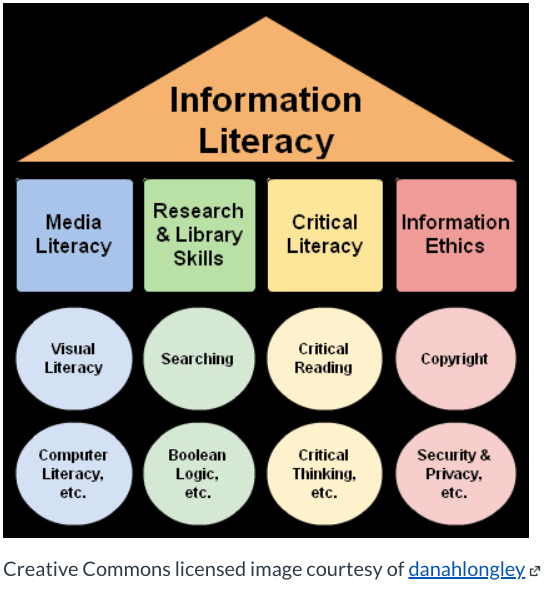
In particular, I want to explore how students can reduce their workload and stress levels by becoming more efficient at completing online tasks in two ways. One, by improving their knowledge of computing skills and use of various educational technologies; and two, by improving efficiency through the use of time management apps, metacognition, and education around healthy habits or “media balance”. According to Common Sense Education, media balance is “using media in a way that feels healthy and in balance with other life activities (family, friends, school, hobbies, etc.)”. This idea is reflected in “BC’s Digital Literacy Framework” which outlines six areas for students to master as they move through the education system. As part of “Digital Citizenship”, students should be taught a “Balanced Attitude Towards Technology”, which includes “manag[ing] the potentially distracting aspects of working digitally” (7) and managing “multiple streams of simultaneous information” (Richardson Loc 168). In recent years, many studies have examined the effects of multitasking and distractions on productivity and focus. With better self-knowledge (metacognition) and tool proficiency, hopefully we can improve student creativity and accomplishment.
Dr. Paul Mohapel, Associate faculty member at Royal Roads University, is a former psychologist and neuroscientist who discusses the impact of multitasking on our brains in “The Dark Side of Our Devices”. He explains that “[…] if you’re deeply immersed in one task, let’s say you’re very focused, and you get interrupted for one minute – it takes you 15 minutes to regain the same level of concentration that you had before the interruption. So you start to see how that becomes very inefficient. You don’t get as much depth in terms of your concentration when you’re trying to do multiple things at the same time” (Mohapel). This is very disconcerting considering the frequency with which people are distracted by notifications on their devices, or the temptation to check an updated social media stream. In teens, where self-control is even more difficult to attain based on brain development, that temptation can be constant.
Dr. Mohapel also references a study out of the University of Sussex, conducted in September 2014, which focused on the effects of multitasking on the brain. This study found that multitaskers, for example people who were watching TV while simultaneously checking their phones, were experiencing thinning of the prefrontal cortex. When “they imaged their brains”, they found that “the more people multitask, [the more] they had certain parts of the brain that actually were shrivelling up and deteriorating [with] less cortical thickness in one area in particular in the prefrontal cortex […] an area called the anterior cingulate cortex, which is important for regulating emotions, empathy, [and] social skills. That area was thinning most dramatically”. Thus, educating our students on how to manage their study time without distractions, and how to enjoy a healthy media balance, is even more imperative.
A significant part of media balance for learners is knowing how and when to use the appropriate tools to support learning, which is based on metacognition. On a very basic level, metacognition is the knowledge of how one constructs knowledge. Geraldine Clareabout et al. define metacognition as: “knowledge of what and how factors act and interact to affect learning processes, knowledge of how to use available information to achieve a goal, knowledge of what strategies to use for particular purposes, and knowledge of when and where particular cognitive strategies should be used” (187). In Clareabout et al.’s article “Metacognition and the Use of Tools” from the International Handbook of Metacognition and Learning Technologies, the authors examine the relationship between appropriate tool usage and metacognition. They postulate that “Learners’ metacognitive skills influence tool usage: The extent to which learners are able to detect their own learning problems and are capable of regulating their own learning will determine the extent to which they will be inclined to use support devices to solve these problems (Mercier & Frederiksen, 2007 )” (189).

Similarly, in “BC’s Digital Literacy Framework”, in the area of “Critical Thinking, Problem Solving, and Decision Making”, it states that “A digitally literate person uses ICT to improve his/her learning performance” (2). Overall, we need to devote more time to digital tools that can support both staff and students in learning more efficiently and improving their media literacy and digital citizenship; this is a topic I would like to explore further in terms of practical applications and supports. For example, the Common Sense Education website pointed me towards the app called Moment, whose motto is “Less phone. More real life.” and is meant to help track and teach users about healthy screen use.
Lastly, in terms of curricular connections, these aspects of media literacy, digital citizenship, and metacognition relate to BC’s Core Competencies for all students. In the categories of Thinking and Personal/Social, we can see that improving use of digital tools and healthy media balance contribute to overall well-being and success. In the core competency of Thinking, it states that “Thinking competence includes specific thinking skills as well as habits of mind, and metacognitive awareness. These are used to process information from a variety of sources, including thoughts and feelings that arise from the subconscious and unconscious mind and from embodied cognition, to create new understandings” (“Core Competencies”). Meanwhile, in Personal and Social, “competency encompasses what students need to thrive as individuals, to understand and care about themselves and others, and to find and achieve their purposes in the world” (“Core Competencies”). A significant part of thriving is being aware of your own learning, and being aware of the impacts of technology on your overall health and accomplishment of goals. By educating students on the best digital tools to support in-depth, effective learning, they will acquire lifelong skills to help them succeed.
Works Cited
“B.C.’s Digital Literacy Framework”. British Columbia, Province of British Columbia, 2020. Accessed July 8 2020. https://www2.gov.bc.ca/assets/gov/education/kindergarten-to-grade-12/teach/teaching-tools/digital-literacy-framework.pdf
Clareabout, Geraldine et al. “Metacognition and the Use of Tools”. International Handbook of Metacognition and Learning Technologies, edited by Roger Azevedo and Vincent Aleven, Springer, 2013. pp. 187-195.
“Core Competencies: BC’s New Curriculum”. British Columbia, Province of British Columbia, 2020. Accessed July 11 2020. https://curriculum.gov.bc.ca/competencies
“Dr Paul Mohapel: The Dark Side of Our Devices”. YouTube, 19 February 2015. https://www.youtube.com/watch?v=M4I4Ma0R330
“How can I use media in healthy ways that give meaning and add value to my life?” Common Sense Education, Common Sense Media, N.d. Accessed 10 July 2020. https://www.commonsense.org/education/digital-citizenship/topic/media-balance-and-well-being
McNee, Darcy. “Module 1: Introductions, Why School, + Reading Review Part A.” LIBE 477B 93S, University of British Columbia, July 2020.
Richardson, Will. Why School?: How Education Must Change When Learning and Information Are Everywhere. Kindle Edition, 2012.
 LIBE Diploma Blog 2020
This is a thoughtful and well-articulated post. I appreciate how you have taken your learning from “Why School” and have woven it into your discussion here. I also appreciate the inclusion of the hyperlinks to outside sources. This further enhanced the reading experience for your audience. The work you are engaging in is important and immediately relevant. I look forward to seeing where your learning takes you.
LikeLike