
This opening section of the course has been enlightening, reaffirming, and at times, overwhelming with the volume of new information! In Theme 1 The Foundation of Reference Services, we have learned about the changing and dynamic role of libraries, information literacy, the research process, the selection and evaluation of sources, and what different reference formats offer over others. For me, the role of the teacher-librarian and finding new resources have been the most significant take-aways this month.
Role of the Librarian in a Tech-Driven World
I have always recognized the value in libraries and librarians, but the learnings in this theme have reiterated the significant, and somewhat new, role of the teacher-librarian as access to knowledge grows more infinite. One might reasonably expect that with easy access to digital information students are more capable of independent research and learning. However, in order to help students become independent learners and critical thinkers, two of the tenets of an information literate citizen (Asselin 5), the teacher-librarian is responsible for providing the tools and skills needed to choose information wisely. In the article “The challenge facing libraries in an era of fake news” by Donald A. Barclay, librarian at the University of California, he compares the skills needed for research in the past versus now. Based on both the breadth and quality of information presented in modern times, “the situation is far more nuanced” (Barclay), which by default, makes the role of teacher-librarian more nuanced as well. He references the American Library Association’s “Framework for Information Literacy for Higher Education”, as a “new approach [that] asks students to put in the time and effort required to determine the credibility and appropriateness of each information source for the use to which they intend to put it” (Barclay). This reflects our current expectations for high school students in Canada, and highlights the guidance required by teacher-librarians in order for students to implement these critical thinking and evaluation strategies.
There is an inverse, perhaps unexpected relationship between the ease of information acquisition, and the student’s ability to choose wisely: “Ironically, technology has actually increased the student’s need for assistance and reference services” (Riedling 14). In the article “Before the Internet, Librarians Would ‘Answer Everything’ – And Still Do”, a reference librarian at New York Public Library sums up the role of the teacher-librarian brilliantly. Rosa Caballero-Li states: “You can find a lot of information online, of course, and that’s great […]. But when you can’t, or when you have too many answers, or you can’t quite distinguish fact from fiction, that’s when you reach out to us” (NPR). Providing a standardized research framework for the students to follow (Riedling 116), in order to avoid spending too much time in Carol Kuhlthau’s first feeling of “Uncertainty” in the research process (Riedling 116, Fig. 1.4) is one of the most significant tools we can provide as teacher-librarians. This also helps guide students to appropriate and reliable sources, in an era where some people and institutions aim to trick the reader with false information. I love this infographic from the International Federation of Library Associations and Institutions on how to avoid fake news and hope we can post one in our library:

There is also a great video, perhaps best suited to grades 4-9, from CIVIX, the group that organizes resources for the Canadian national Student Vote. It explains how disinformation is spread: https://www.youtube.com/watch?v=xDLohXNgF4o
I will admit that in the past, I have perhaps relied too heavily on the student’s ability to filter through information from Internet search engines on their own. Although I check in on individual research and website use during inquiry tasks, it would be more effective to “review functions of the search tool with students before they begin” (Riedling 113) in a more in-depth way. I would like to assign more formal, general research activities on how to use search engines and databases before jumping into their assignments. In addition, letting the librarian be the only expert on database use is an error I am working to fix; as the teacher, I too should be able to use the reference databases and programs like NoodleTools in the same way the students are expected to.
Budgetary Constraints and New Resources
One of the biggest surprises for me were the “Standards for School Library Collections” outlined in pp. 24-51 of Achieving Information Literacy (AIL)put out by the Canadian Association for School Libraries. I was shocked to find that my school library does not meet Acceptable or Exemplary standards in most categories.
I learned that we only get $8 of funding per student at our school. This is far below the Acceptable $36-45 per student, suggested in Table 8 by AIL in 2006 (35). 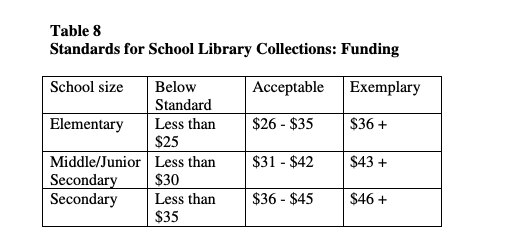
And yet, I find the quality of resources to be effective for the courses I am teaching, and that my students still demonstrate strong research and critical thinking skills in the process, a testament to our teacher-librarians. Similarly, I did not realize the high cost of electronic reference sources, which makes access to resources that have “high precision” results more difficult (Riedling 110). Some people associate digital information with free information, or at least less expensive information, but this is not the case for databases that rely on myriad authorities and up-to-date information. As a Social Studies teacher, I am grateful for Curio, the CBC streaming service paid for by the school library budget, since it provides access to reliable videos on both historical and contemporary topics. However, this cuts into the overall library budget for reference databases like JSTOR (Click here for an interesting article on the controversy of JSTOR). The extensive decision-making process needed to keep library collections relevant was an important take-away for me in this part of the course.
Finally, I learned about the BCERAC website during this theme, and I know it will be an invaluable resource for me as I continue my training and become a teacher-librarian. ERAC (Educational Resource Acquisition Consortium) and BCEM (British Columbia Education Marketplace) have joined forces on this new venture titled Focused Education Resources with a very detailed and useful website for resources. I was particularly impressed with the K-12 Evaluated Resource Collection in the Education & Curriculum tab, where I searched for a novel I am currently teaching titled The Marrow Thieves by Cherie Dimaline. It extensively covers Curriculum Fit and Social Considerations for teaching the novel; among other things, it also highlights audience and authenticity as a First Peoples Text. This is an invaluable tool for me as a teacher; as a librarian, this type of detailed criteria will be indispensable when looking to advise staff on resources or to purchase new texts.
Concluding Thoughts
Overall, this has been an engaging part of the course, where I have been introduced to important references and resources that I am certain to use for years to come. It also gave me the opportunity to work more closely with and learn from the teacher-librarian at my school, the beginning of a great mentorship filled with insights into our ever-changing roles as media experts.
Works Cited
Asselin, Marlene, et al. Achieving Information Literacy: Standards for School Library Programs in Canada. Canadian Association for School Libraries Association, 2006.
Barclay, Donald A. “The challenge facing libraries in an era of fake news”. The Conversation. January 4, 2017. Accessed 28 January 2020. https://theconversation.com/the-challenge-facing-libraries-in-an-era-of-fake-news-70828
CIVIX. “CIVIX Explains: Disinformation”. YouTube, uploaded by NewsWise, 6 September 2019, https://www.youtube.com/watch?v=xDLohXNgF4o
“Focused Education Resources: Building Capacity. Advancing Education”. Focused Education Resources. 2019. Accessed 28 January 2020. https://bcerac.ca/
Jacobs, Alan. “JSTOR’s Hidden Power”. The Atlantic. December 10, 2013. Accessed 28 January 2020. https://www.theatlantic.com/technology/archive/2013/12/jstors-hidden-power/282218/
NPR Staff. “Before the Internet, Librarians Would ‘Answer Everything’ – And Still Do”. National Public Radio. December 28, 2014. Accessed 28 January 2020. https://www.npr.org/2014/12/28/373268931/before-the-internet-librarians-would-answer-everything-and-still-do
Riedling, Ann Marlow, et al. Reference Skills for the School Librarian: Tools & Tips, Third Edition. Santa Barbara, Linworth, 2013.
The International Federation of Library Associations and Institutions. “How to Spot Fake News Infographic”. January 2020. Accessed 28 January 2020. https://www.ifla.org/node/11175
 LIBE Diploma Blog 2020
Well done! This was a powerful and personal reflection on your experiences, learning and key takeaways from our first theme of the course. Your highlights, reminders, reflections and selections of key materials and resources really resonates and can provide much insight and value to your small group and other readers. A dense blog post, full of useful links, examples, followups, and research that demonstrate a very solid foundation of understanding and a full gathering of knowledge and examples for further growth. Thank you for this post, as it was very well done, designed, tagged, and written.
LikeLiked by 1 person
I appreciated your honest and reflective nature as I read though your first post. Understanding that classroom teachers need to work with the librarian to create shared knowledge is vital. I think its easy to assume that all students know how to conduct basic research but this is far from the truth. By breaking the research process up and exposing students to the basics of search engines, teachers (together with the library media specialist) can create an engaging environment that will allow for greater success. Thank-you for sharing!
LikeLiked by 1 person
Thank you, Sarah!
LikeLiked by 1 person
Hi Sophie,
Let me know if you can get one of those “fake news” posters in your school, I think it would be helpful in my school library as well! I am also still looking for more strategies to help students independently use search engines and I think this poster would help with media literacy.
Thanks for the post,
Catherine
LikeLiked by 1 person
Thanks for reminding me to look into that!
LikeLiked by 1 person