Learning Log on Module 9
This week, we were asked to reflect on “opportunities that embrace inquiry and design in the library” (Delvecchio) after exploring various formats that encourage students to build their own worlds through writing, drawing, and creating.
Although the resources were diverse in their formats and in their attention to different age groups and creative pieces, the central point for me was that these opportunities for inquiry, art, and design develop communities and relationships between people who would maybe typically not get the chance to interact. The control is in the hands of the students, empowering them to succeed. Furthermore, providing new spaces for building and creation helps to break down stereotypes.
In Christopher Hunt’s “MakeryBakery”, he explains that one of his reasons for building MakerSpace activities was to “break[] down gender barriers to certain kinds of making” by offering activities that were traditionally/historically attributed to boys or girls (Module 9). He discovered that in all his #MakerSpace activities, “Even when gender roles amongst adults are often still quite delineated, the upcoming generation of students excitedly leaps, with equal gusto and pride, into coding, sewing, woodworking, baking, what-have-you, which is as it should be. Gender is becoming less and less an issue within the growing Makerspace ethos” (Module 9). When students can see the physical product of their combined efforts in creating something new, there is a sense of ownership and pride – “I made that!” – that exists outside of any preconceived ideas on identity or ability. The focus is on the journey and the joy. Since MakerSpaces are “a learner-driven experience“, even if the product doesn’t turn out the way it was intended to, “You’re not really looking for the end product. How you get there is more important” (Maker Ed).
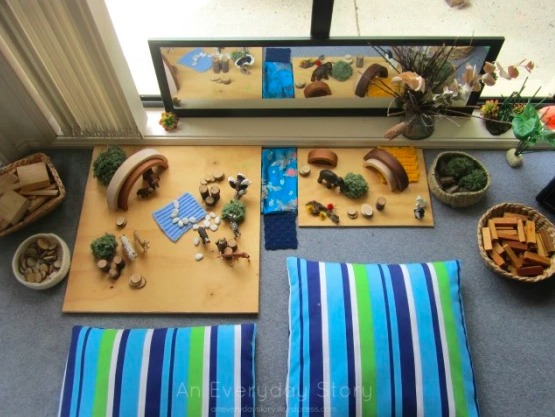
Similarly, in “Story Studio” by Angela Meredith, she explains that the Story Workshop “strongly supports the needs and rights of children with disabilities to learn within a heterogeneous community of peers” (Meredith, Module 9). This is achieved through accessible learning materials that are “loose” and encourage “creative, ‘playful literacy'”,(Meredith, Module 9) and where students are given the freedom to create any story they wish, or to build stories within familiar parameters, such as family traditions (Good, Module 9). Stephanie Good noted that her Story Studio was successful at various grade levels: “[s]tudents in Grades 5 and 6 interacted with story studio materials with the same enthusiasm as our Kindergarten students!” (Module 9). Regardless of their age, when students are given the directive to control the outcomes of their learning through building and play, they tend to come to life in new ways.
This idea of control also relates to this module’s reading about fan-fiction (fanfic) titled “Fellowship of the Fans: Connecting with Teens through the Magic of Fan Fiction” by Anne Ford. She explains that fanfic provides the freedom for writers to “change characters’ genders, ethnicities, sexual orientations, and physical or mental abilities”. Teen writers can control the characters in their fictional world, and are buoyed by the structure that fanfic offers in its pre-determined elements of plot. There is a safety in writing within the parameters of someone else’s basic storyline. Nancy-Anne Davies, a librarian in Toronto who is well-versed in fanfic and its attributes, states: “’One of the things that lies at the heart of what makes fan fiction so dear to people is its ability to take characters and adapt them and claim spaces that they’ve previously been denied access to’” (qtd. in Ford). This idea of populating spaces, even fictional ones, with diversity in its many forms, again creates a new community where people from different backgrounds feel accepted. Like Hunt’s #MakerSpaces, previous stereotypes and identities are shed in the joy of finding new communities and creative opportunities.

As a teacher-librarian, I would find out whether there is an interest in fanfic at my school, both through informal conversations with students, and through book displays that inform the community on the history of fanfic and its modern day iterations. Most people are aware of Shakespeare’s Romeo and Juliet, but do they know that it was based on a narrative poem, and an Italian novella before that? (Ford). I would combine these historical examples with contemporary ones to show that fanfic is indeed everywhere, and completely viable as a genre. This could lead to lunch hour book clubs or writing sessions, where students share their fanfic forays in a safe setting.
Lastly, the Sketchnoting resources this module reminded me of the importance of visual design in focus and learning. Carrie Baughcum gives some ideas on how to use Sketchnotes in the classroom on her blog:
- “When reading text or listening to information: Students can doodle their learning, what they are visualizing right next to the text in the book
- Give Them Permission to Doodle: Allow students to share their learning visually. Give them permission to share their thoughts and thinking on paper (its always about the doodle not the art)”

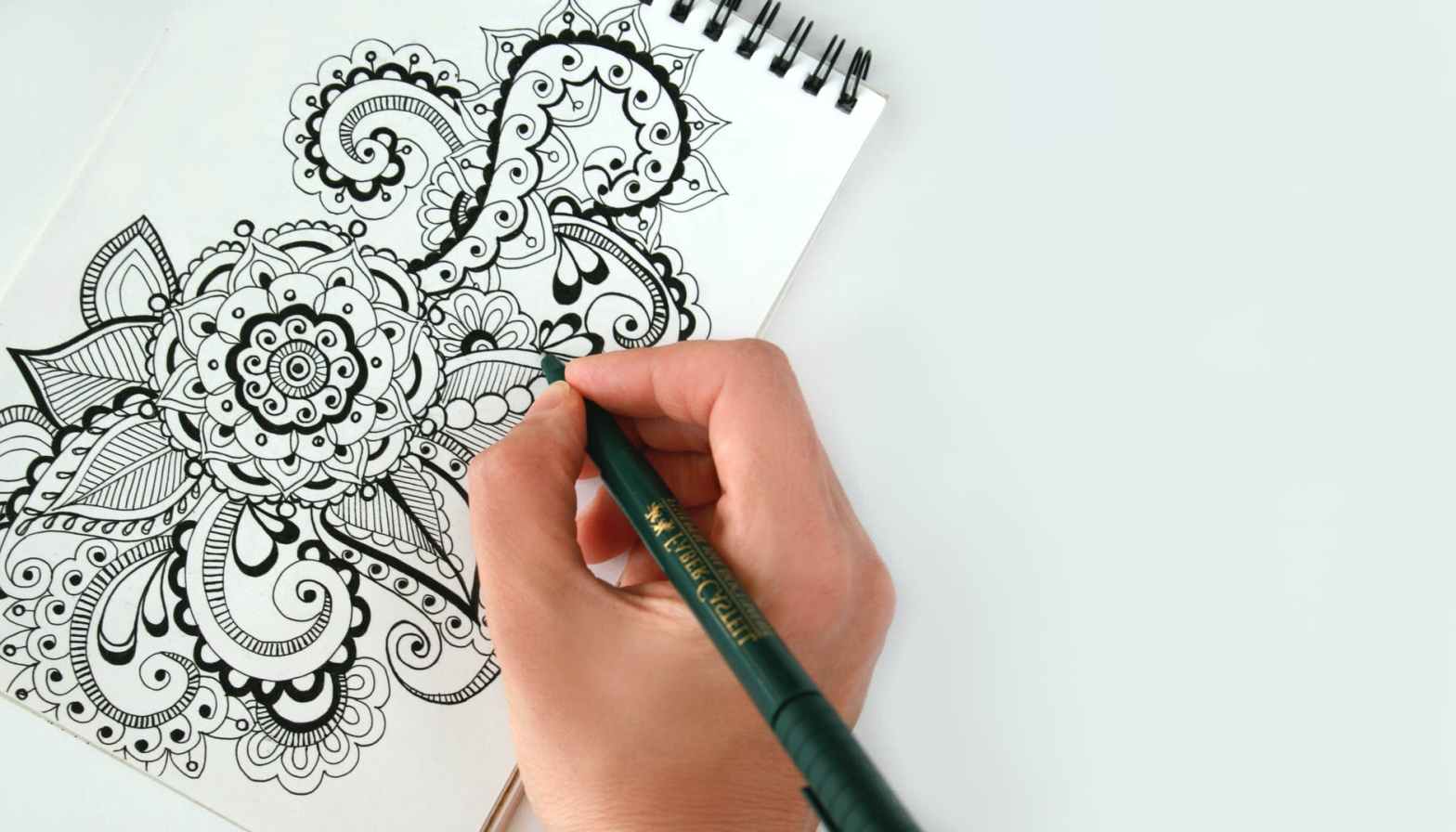
As a classroom teacher, I have often encouraged students to make doodles or visuals to help them remember information. However, reading Baughcum’s post and learning about the basics of Sketchnotes from Doug Neill meant that doodling was front of mind these past few weeks, with positive outcomes for both me and my students.
In terms of the doodling and its effect on my students, I found it to be a useful tool to keep focus. During an Anti-Racism workshop last week, students watched a Zoom presentation, with live speakers who shared photos and slides with information on the topic. Despite the gravity of the topic, and some engaging speakers, the “wall” between the screen and students can often lead to wandering minds with a desire to move or to check a smartphone for status updates. Since the “verbal to visual” was on my mind, and since I had assessed my own use of doodles as a technique to stay focused during high school and university lectures, I quietly put a piece of blank paper on each grade 9 student’s desk, and wrote on the board: “I find that doodling during long presentations can help keep my focus”.
Many of them started doodling immediately after I wrote that, while others had to be coaxed to read the board. One student exclaimed: “Oh! We can doodle on this?!” and got right to it when I explained what the paper was for. And although most of the doodles weren’t related to the topics presented, they did help the class with focus, and the students keenly asked one another what they had drawn after the presentation ended. There were a lot of compliments and also realizations that some students had drawn the same things. In fact, it was quite a window into their personalities to see what they are comfortable drawing. It was a moment of unexpected team-building in the classroom; the space is theirs, they are comfortable enough to create and share in it. I think the exercise also highlighted the value of the doodling and the visual as tools in educational settings beyond the walls of the art classroom.
One way to incorporate Sketchnotes or doodles into library resources would be to adapt Baughcum’s idea of using post-it notes for doodles while reading information. You could collaborate with a class of English students, for example, where they make doodle post-its while reading an independent novel. They could choose their favourite one and leave it in the book for the next person who reads it. This person could add to it or make a new one. Of course, this exercise would need vetting from teachers and T-Ls to be sure all post-its were appropriate, but it might be a neat way to build a community of readers.
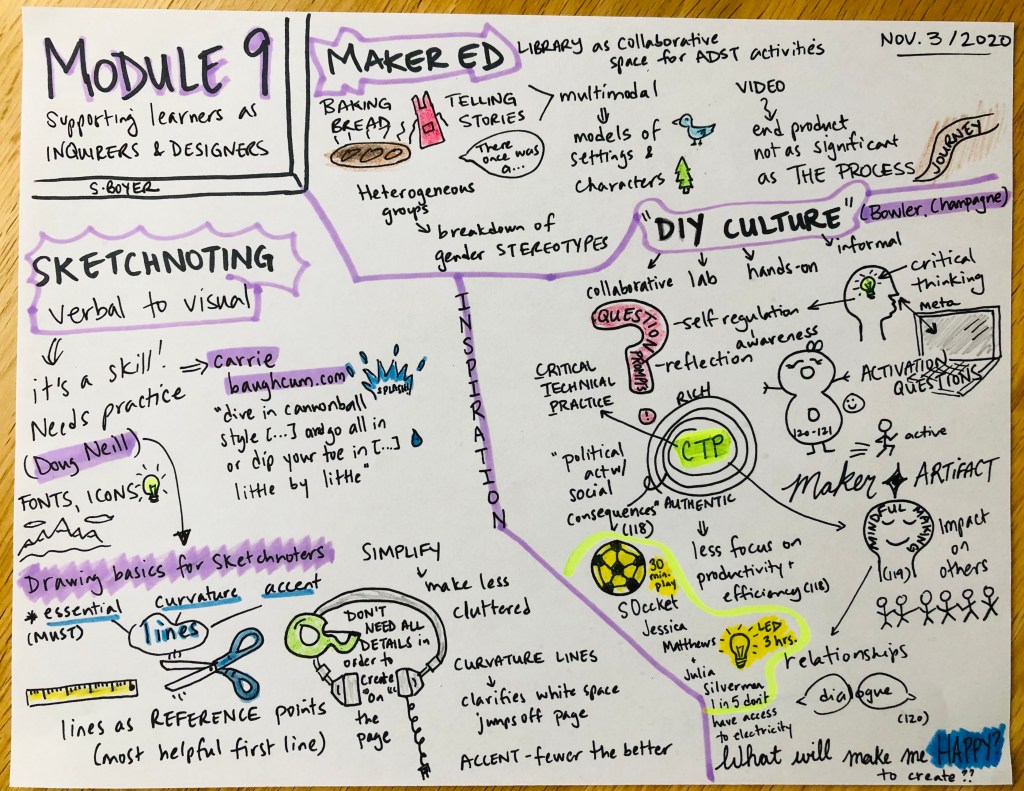
In terms of my own learning, I made Sketchnotes for some of the sources from this Module, and looking back on them a week later, the ideas come back more quickly than if I were reading simply written notes on a page. For example, in reference to Bowler and Champagne’s article “Mindful makers: Question prompts to help guide young peoples’ critical technical practices in maker spaces…”, I wrote “Maker-ARTIFACT” using different fonts as recommended by Neill. This immediately stood out to me first when revisiting the notes. Indeed, whether the creation is tech-related or not, when we make new things – stories, doodles, bread – we are making artifacts that represent who we are at one point in our lives. Even something as silly or insignificant as a doodle on a post-it or a handout is an artifact you’ve left behind, and I think one of the appeals of MakerSpaces and Sketchnotes is that the possibilities for design are endless. It’s yours to choose and run with, big or small. And in a space where the answers are often finite, the classroom, having infinite possibilities is freeing.
In fact, this is one of the principles that makes school libraries so appealing; they are spaces of infinite possibility where students are given the opportunity to inquire about any topic, or to read titles from hundreds or more authors in a safe space. Although MakerSpaces are a bit more challenging in secondary school libraries, particularly if your school already offers Home Economics/Foods or a robotics program, they can still build community through literacy and collaboration.
Works Cited
Baughcum, Carrie. “Sketchnoting: I just don’t know how to start.” Carrie Baughcum: Life.Learning.Doodles…Are Heck Awesome!, 4 Aug. 2017, carriebaughcum.com/how-to-start-sketchnoting/. Accessed 3 Nov. 2020.
Bowler, Leanne, and Ryan Champagne. “Mindful makers: Question prompts to help guide young peoples’ critical technical practices in maker spaces in libraries, museums, and community-based youth organizations.” Library & Information Science Research, vol. 38, no. 2, Apr. 2016, pp. 117-24, doi.org/10.1016/j.lisr.2016.04.006. Accessed 3 Nov. 2020.
Delvechhio, Jennifer. “Module 9: Supporting Learners as Inquirers & Designers.” LLED 462-63A, University of British Columbia, November 2020.
Ford, Anne. “Fellowship of the Fans: Connecting with Teens through the Magic of Fan Fiction.” American Libraries, American Library Association, 1 Nov. 2016, americanlibrariesmagazine.org/2016/11/01/fellowship-of-the-fans-fan-fiction/. Accessed 10 Nov. 2020.
“Maker Ed: The Impact of Maker Education.” YouTube, uploaded by Maker Ed, 6 May 2015, http://www.youtube.com/watch?v=3Ml9j1UkeI4&feature=emb_logo&ab_channel=MakerEd. Accessed 3 Nov. 2020.
Neill, Doug. “A Warm-up Routine for Sketchnoters.” YouTube, 13 June 2019, https://www.youtube.com/watch?v=kdV7A7e8IGg&feature=emb_logo. Accessed 3 Nov. 2020.
Neill, Doug. “Drawing Basics for Sketchnoters.” YouTube, 21 Sept. 2018, http://www.youtube.com/watch?v=po0IEYeLlq4&feature=emb_logo&ab_channel=VerbaltoVisual. Accessed 3 Nov. 2020.
 LIBE Diploma Blog 2020