
Learning Log #3, Module 7
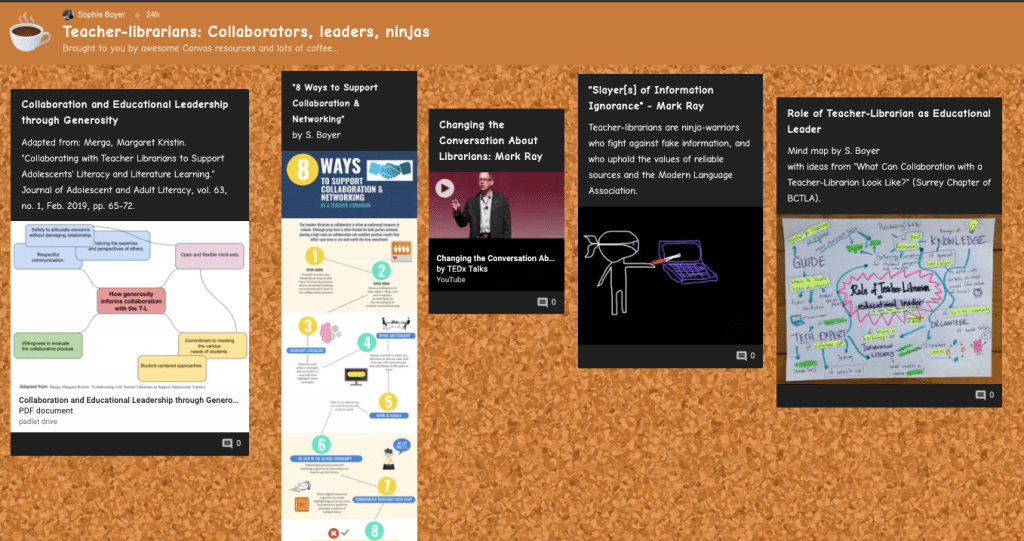
For this learning log, we were encouraged to try Padlet to present our learnings, so I have created my first “wall” titled “Teacher-librarians: Collaborators, leaders, ninjas”. I took the ninjas concept from Mark Ray’s TedxTalk, “Changing the Conversation about Librarians”, which focused on the future of librarians as “Slayer[s] of Information Ignorance (with a black belt in ‘think-quando’)”, among other creative job titles. Information Media Literacy is one of the most important collaboration roles for a teacher-librarian (Surrey BCTLA), and for educators in general, and I like the modern twist of being the top of your game as a T-L, a “black belt” who knows how to defeat disinformation and fake news, an image that conjures a ninja in my mind’s eye.
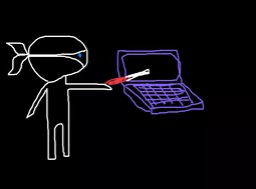
I had fun using the drawing tool in Padlet to make my own ninja slaying a laptop screen (symbolic of information literacy). This web application is a tool I think my own secondary students would enjoy. I often ask them to create mind maps to demonstrate understanding of a topic, and Padlet would be a great, and fun, digital alternative. T-Ls are often considered technology experts, “who foster student and teacher technological capacities and digital literacies” as part of “Cultivating Effective Instructional Design to Co-plan, Teach, and Assess Learning” (CLA 15). They are also responsible for the ICT skills of “Evaluating & Curating Websites and Apps” (Surrey BCTLA); Padlet is an example of an easy-to-use online tool that a T-L could share with secondary teachers, providing new ideas for creative presentation of facts.
Sharing a resource like Padlet not only promotes collaboration between the teacher and the T-L, but the students could collaborate with one another through Padlet, adding to their wall simultaneously as they discover new sources on a topic. In this way, we are encouraging the “teamwork and collegiality” which are considered as highly valuable by modern society (Brown 2004, qtd by Merga, 66).
Although I tried several digital tools for this learning log, at one point I needed a screen break and chose to present ideas on “The Role of the Teacher Librarian as Educational Leader” with an old-school mind map. I like that you can add your own photos to the Padlet in a seamless way, combining digital and non-digital artefacts. For the mind map, I combined ideas from the Surrey BCTLA “What Can Collaboration with a Teacher-Librarian Look Like” and also my own understanding of educational leadership of the T-Ls in my own school.
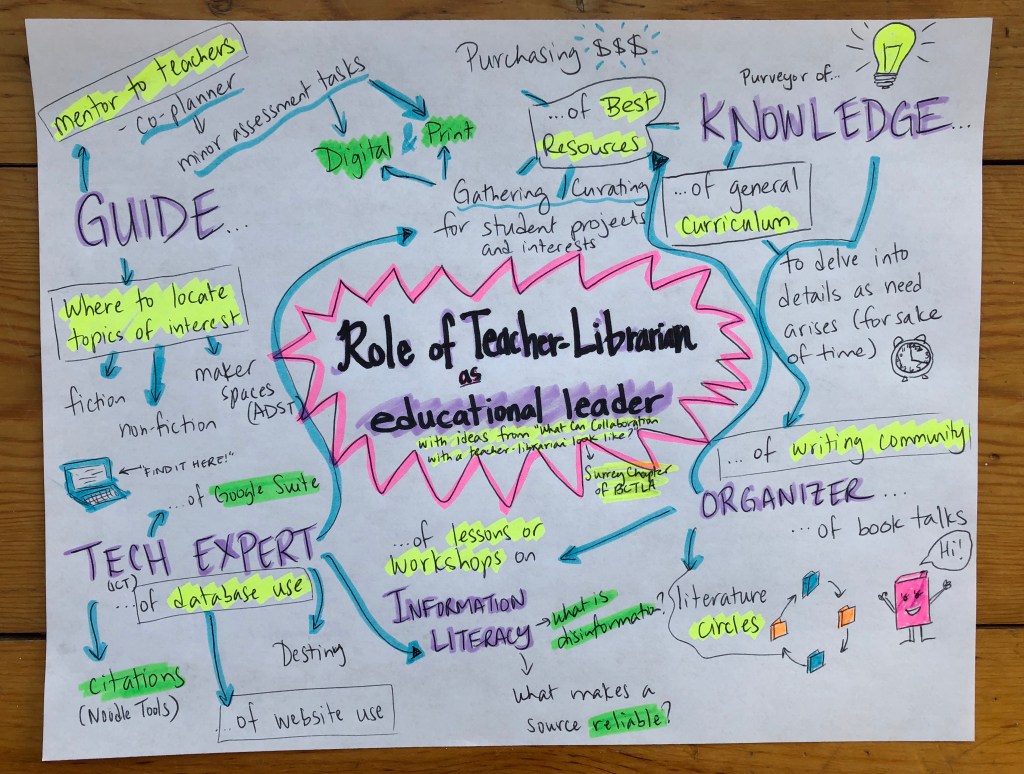
First and foremost is the concept of the T-L as guide or mentor. It is one of the main reasons I chose to pursue this diploma, so it is a significant point for me. According to the T-L at our school, “collaboration is the model here”, and the T-Ls have provided mentorship and support for me throughout my eight years at the school. Like Stephanie in Merga’s article “Collaborating With Teacher Librarians to Support Adolescents’ Literacy and Literature Learning”, the T-Ls at my school have a “relatively high influence in […] collaborative relationships [as] reflective of [the] strong relationships and position of influence [they have] in the school” (69), and my hope is to continue this leadership in the future. Teaching can be isolating at times, and the relationships I’ve built with the T-Ls have helped me feel that I am on less of “an island” when it comes to reaching curriculum and student goals (MacKenzie 3). Collaboration builds confidence for all parties involved, and strengthens relationships and ties to the school community.
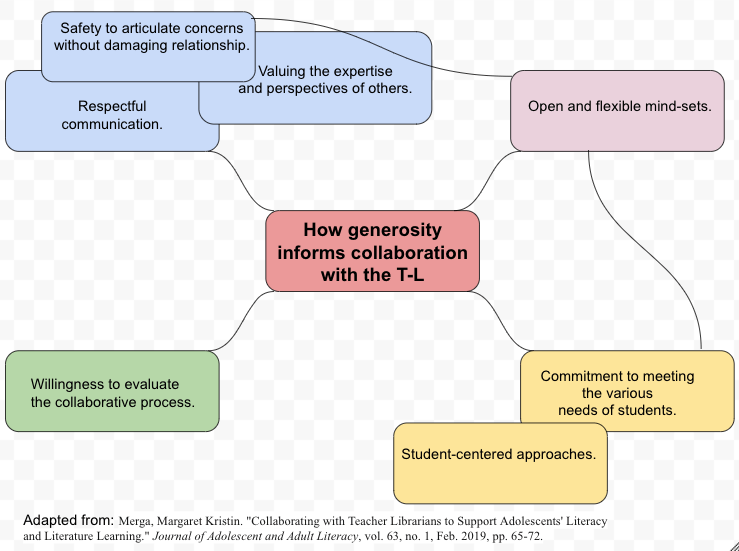
Any leadership role is built on relationships, and the T-L is no exception. As Jennifer Delvecchio points out, a good mentor is one who considers “would I appreciate having this, or being offered this, or doing this?”, three questions with service and kindness to others at their core. Similarly, one of the key points that stood out to me in Merga’s list of 11 characteristics of good collaborations was “Generosity”. It stands on its own as #8 of the 11 principles, but I would argue that many of the other ideas stem from generosity, as shown in the spider diagram I created in Google Drawings titled: “Collaboration and Educational Leadership through Generosity” (also included in the Padlet). Being respectful, and valuing the opinions and learning styles of students and teachers, starts with a generous mindset. Delvecchio notes that “Flexible programming and service is inherent as the basis in the very first libraries“. Open-mindedness and flexibility are also related to strong collaboration and generosity, as they demonstrate an understanding for others and honour the validity of teacher prep time.
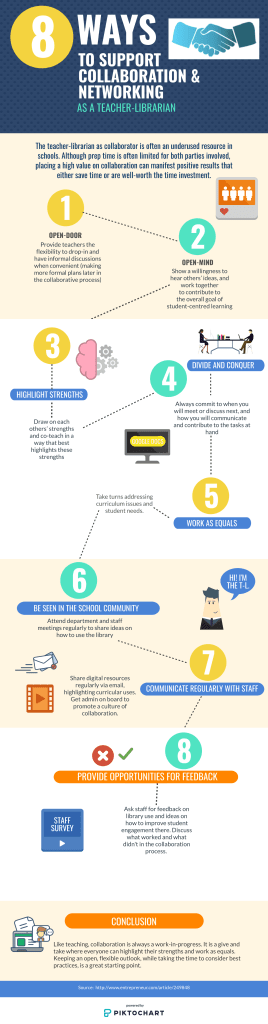
As Trevor MacKenzie points out in his article “Classroom Inquiry’s Secret Weapon: The Teacher-Librarian”: “I have often stopped by the library unannounced, with the intentions of just asking a quick question […that] ends up in a rich, inspiring discourse that goes well beyond” this (2). I have also found this to be true, which is why I have included the concept of an “Open Door” as one of the “8 Ways to Support Collaboration & Networking as the Teacher-Librarian” in my Piktochart on the topic (inspired by colleague/classmate Tracey Williams, and included in the Padlet). The idea is to “Provide teachers the flexibility to drop-in and have informal discussions when convenient (making more formal plans later in the collaborative process)”. This respects the limited “time availability” teachers may have to collaborate, which was highlighted as one of the major issues in Merga’s survey (68).
The “Open Door” also connects to the Standards of Practice for School Library Learning Commons in Canada, which has a “Focus on Collaboration”. In the introduction to the standards, Sheila Morrisette, Principal of Fraser Heights SS in Surrey, states that the school library is “a learning area for everyone including teachers and students. Our teacher-librarian collaborates with other teachers to plan lessons and helps teachers to develop best practices and strategies. She has an open door policy for all students” (6). And I would guess the T-L mentioned would have the same open door policy for staff; her learning commons sounds like a safe, comfortable space where all are welcome. This safety promotes collaboration.
In my experience, the more you collaborate with other teachers, the easier it becomes to accomplish shared goals as you find your work-rhythm and capitalize on your individual strengths as educators. This is the basis of #3 of my 8 Ways to Support Collaboration Piktochart, which is to “draw on each others’ strengths and co-teach in a way that best highlights these strengths”. MacKenzie views it as “a collaborative alliance”, where the T-L “discover[s his] teaching strengths and weaknesses objectively, without judgement” (3). He also concludes that by including the T-L more frequently, it “becomes a powerful cycle of support that gains momentum and benefits the students, the teacher, and the culture of learning in the school” (4). Every time you collaborate with generosity (and no judgement), you are strengthening the trust between colleagues, and making the overall school environment more enjoyable. This trust is also built on the respect of seeing each other as equals in the collaboration process: to “Divide and Conquer” the workload, and to “Work as Equals” no matter what the situation (“8 Ways to Support Collaboration…”).
Finally, communication is a key piece for any collaboration work to be useful in all its stages: planning, delivering, and debriefing. Collaboration can be promoted in the school through administrative support, as noted in Merga’s article (68), and also through regular communication from the T-Ls, be it staff/department meetings or through emails to staff. Throughout the collaborative process, a simple back and forth via emails, conversations, or shared documents can be effective, especially as we often work remotely from one another. In this exchange, educators should be made to feel “[s]afe[] to articulate concerns and issues without irrevocably damaging the collaborative relationship” (Merga 71), so it is important to keep an open mind while giving feedback. To cap off collaborative work, debriefing is important to highlight what was successful and what could be tweaked in future versions of the assignment (Surrey BCTLA). These are often informal conversations where you celebrate anecdotal evidence of success, a small victory in the often long periods of teaching time that goes unnoticed or uncelebrated.
Overall, I flexed some new ICT skills in this assignment, working with Padlet, Piktochart, and creating a spider diagram in Google Drawings for the first time. It was challenging and time consuming, but like collaboration, I am building the skills for future endeavours, which no doubt will be easier for this experience.
Works Cited
(CLA) Canadian Library Association. Leading Learning: Standards of Practice for School Library Learning Commons in Canada. 2014. http://llsop.canadianschoollibraries.ca/wp-content/uploads/2016/09/llsop.pdf. Accessed Oct 27 2020.
MacKenzie, Trevor. “Classroom Inquiry’s Secret Weapon: The Teacher-Librarian.” Canadian School Libraries Journal, vol. 3, no. 1, Winter 2019, journal.canadianschoollibraries.ca/classroom-inquirys-secret-weapon-the-teacher-librarian/. Accessed 27 Oct. 2020.
Merga, Margaret Kristin. “Collaborating with Teacher Librarians to Support Adolescents’ Literacy and Literature Learning.” Journal of Adolescent and Adult Literacy, vol. 63, no. 1, Feb. 2019, pp. 65-72.
Ray, Mark. “Changing the Conversation About Librarians.” YouTube, uploaded by TedXTalks, 7 June 2016, http://www.youtube.com/watch?v=IniFUB7worY&feature=emb_logo&ab_channel=TEDxTalks. Accessed 27 Oct. 2020.
Surrey Chapter of the BCTLA, and The Surrey Teachers’ Association. “What Can Collaboration with a Teacher-Librarian Look Like?” Surrey Chapter of the BCTLA, 17 Dec. 2019, surreychapterofthebctla.com/2018/12/17/what-can-collaboration-with-a-teacher-librarian-look-like/. Accessed 27 Oct. 2020.
 LIBE Diploma Blog 2020
One thought on “Teacher-librarians: Collaborators, Leaders, Ninjas”