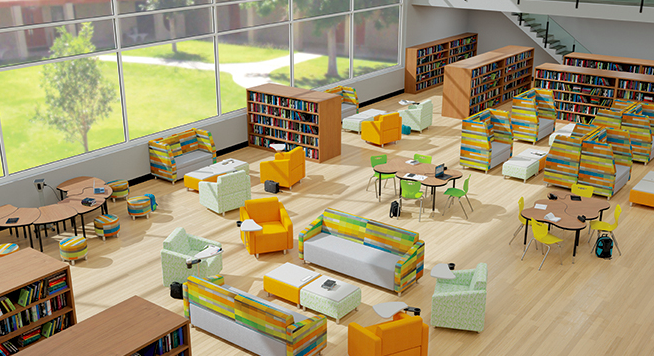
Source for feature image: Mooreco
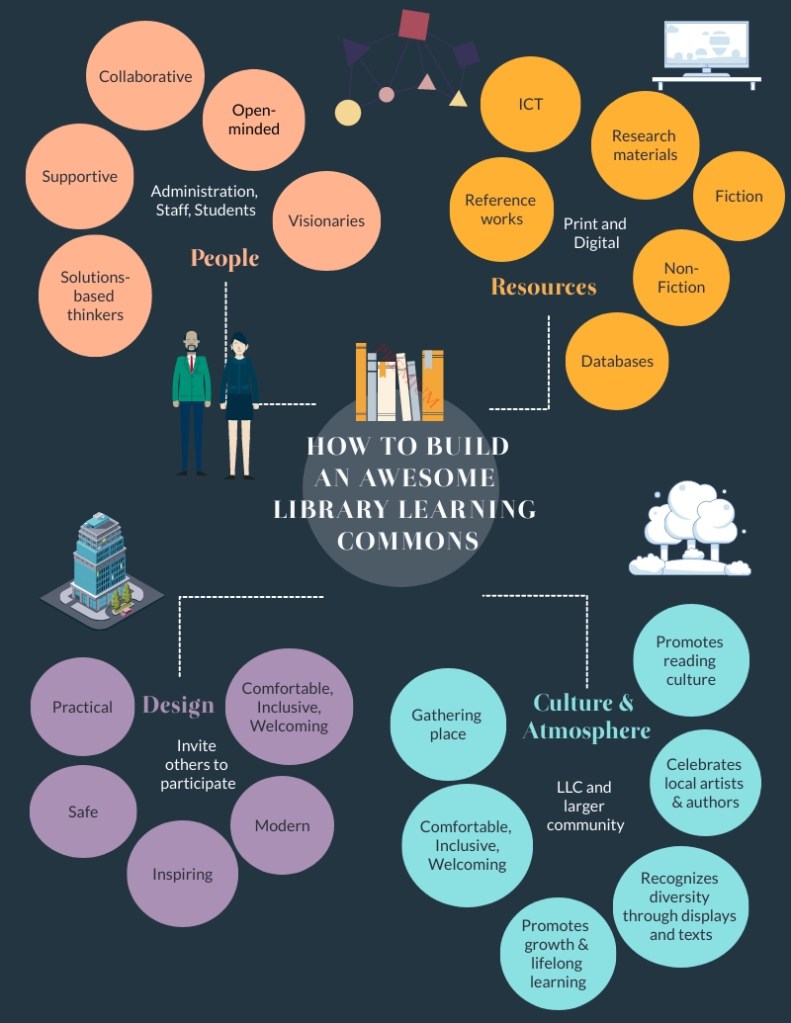
How to Build an Awesome LLC* (Infographic and Video showing animation of Infographic can be found below)
| People (Administration, staff, students) Collaborative Open-minded Supportive Visionaries Solutions-based thinkers | Resources (Print and Digital) Reference works Databases ICT Research materials Fiction Non-fiction |
| Design (Invite others to participate) Practical Safe Inspiring Modern Comfortable, inclusive, welcoming | Culture and Atmosphere (LLC and larger community) Reading culture promoted in school Celebrates local artists and authors Recognizes diversity through displays and texts Comfortable, inclusive, welcoming Gathering place |
*In the interest of time and space, I won’t be able to address all of the items in the chart! I will touch on the ones that relate most with the readings for this module.*
The People
The first pillar of a great school Library Learning Commons (LLC) is the people. Certainly the Teacher-Librarian is central to the picture, and has a big role to fulfill, but support from the larger community is necessary. It not only lessens the burden of the myriad roles a T-L plays, it also capitalizes on the talents of others.
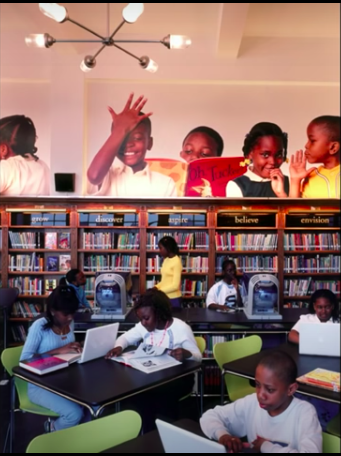
For example, in his discussion of rebranding of school library design in New York City, Michael Beirut explains how through a network of community supporters, they were able to design an inspiring space for learners. He describes the first school he impacted with his design community: “It has this glorious frieze of the heroes of the school, oversized, looking down into the little dollhouse of the real library”. The photos had been taken by his wife, a professional photographer, who happily volunteered to help out. Beirut then got local artists involved in designing and painting murals, or creating collages of images and objects, all contributing to a unique, inspiring atmosphere for the students in the different schools. In all, 40,000 students go through these spaces every year. However, Michael Beirut could not have achieved this vision with his skills alone.
In the same way, Teacher-Librarians need support, not only from the larger community such as the school district or Parent-Teacher-Associations who can provide ideas and funding, but also from their school administrators. Working closely with school leaders is one of the central standards for “Advancing the Learning Community” in the “Standards of Practice for School Library Learning Commons in Canada” (SOP). One of the themes for the standard is “Principal Collaborative Role” (13). A well-established school LLC functions best when you have “Principals [who] are advocates and ambassadors for advancing the LLC” and who “encourage all teachers to work collaboratively with LLC staff to utilize programs, spaces, resources and technologies for learning” (13). Therefore, scheduling regular times to meet with your principal to discuss a shared vision for the school LLC is important. The T-L at our school participates in Curriculum Council meetings in order to regularly communicate with teacher leaders and school administrators.
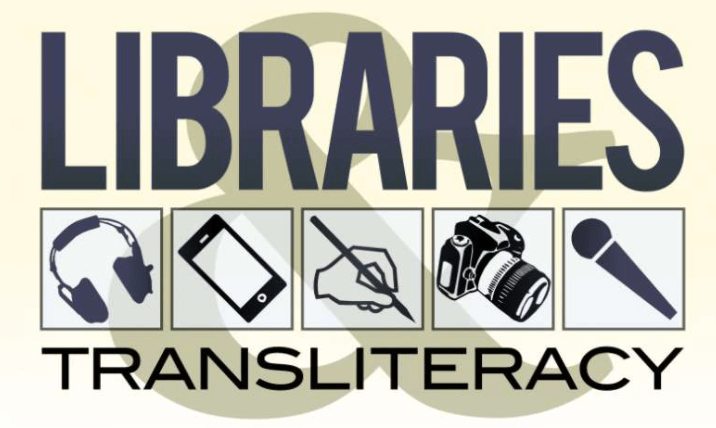
Working collaboratively with teachers is also significant to the development of a school LLC. Teachers have a good sense not only of curriculum needs, but also student learning needs, which are constantly shifting as the list of literacies continues to grow. The SOP states that the T-L is responsible for “Literacy Leadership” in the form of “lead[ing] the school community in designing learning for transliteracy” (17). Transliteracy means that you are able “to read, write and interact across a range of platforms, tools and media from signing and orality through handwriting, print, TV, radio and film, to digital social networks” (28). This wide range of skills is best addressed when teachers and T-Ls work as a team to instil the knowledge needed for lifelong learning across these literacies. As Terri Hayes points out in her article Library to Learning Commons, the role of the T-L has changed, where now they are “instructional leaders, supporting and collaborating with every teacher in the school, promoting inquiry-based learning and fostering a thriving reading culture”. This is a symbiotic relationship, where the teacher and T-L are continually exchanging new ideas to create better resources and learning opportunities for the students.
I also believe that hearing directly from students on what they need will help foster a better space for learning and skill development. This can occur through informal conversations or through anonymous surveys conducted either in the classroom or the LLC itself.
The Design, Culture, and Atmosphere
As mentioned earlier, Michael Beirut highlights the importance of working with others to create an inspiring design for libraries, where people want to come read. The library space should be inviting and welcoming to diverse populations of students. In her TedTalk “What to expect from libraries in the 21st century”, Pam Sandlian Smith speaks about libraries as central to communities in the United States. She mentions their significance after natural disasters – that they turn into distribution centres, a place of support and a “hub” for the local community. In general, libraries should be places of comfort and acceptance, regardless of the person or situation presented.
Smith also references a young boy who asked if he could “rent out” a story hour room in the library, and even offered to put on a puppet program for library clientele on Friday afternoons. It was a resounding success, and it was only later that the librarian discovered he was homeless at the time; she said “Little did I know that when he asked that question, how important it was for him to have that space to create, to think, to fulfill some dreams. He needed someone to have the instinct to say ‘yes’”.

This instinct to say ‘yes’ is one of the things I would like to remember myself as a teacher and teacher-librarian who leads a great LLC. Yes, you are welcome; yes, you are free to try and create new things; yes, you are accepted, with no judgment; yes, your opinion counts; yes, you are encouraged to expand your knowledge and ask questions. Being open-minded and understanding means that you will build strong relationships with the students and staff in your community, and people will want to spend time in the library resource space. It can only become a hub of activity if everyone feels invited there. Smith concludes her TedTalk with a nod to libraries as democratic in their acceptance of all people; she says “Libraries are places that support creativity, community, innovation, and entrepreneurialism. We are the cornerstones of democracy. Everyone has a seat at the table.”
One way to show a commitment to diversity is by purchasing and prominently displaying texts written by people of various backgrounds and cultures. Linking these displays to current or historical events helps students make connections beyond a singular book, relating it to a larger social, political, or economic context. For example, when the Black Lives Matter protests started in June 2020, our school library created an entire wall display of texts by black authors who showcased historical wrongs in their writing, but also had strong messages of hope. Furthermore, they have a more permanent display of Indigenous authors, with rotating titles, in recognition of their importance to Canadian history and society. Students need to recognize themselves in the narratives purchased by the school library so that they can feel seen and important.
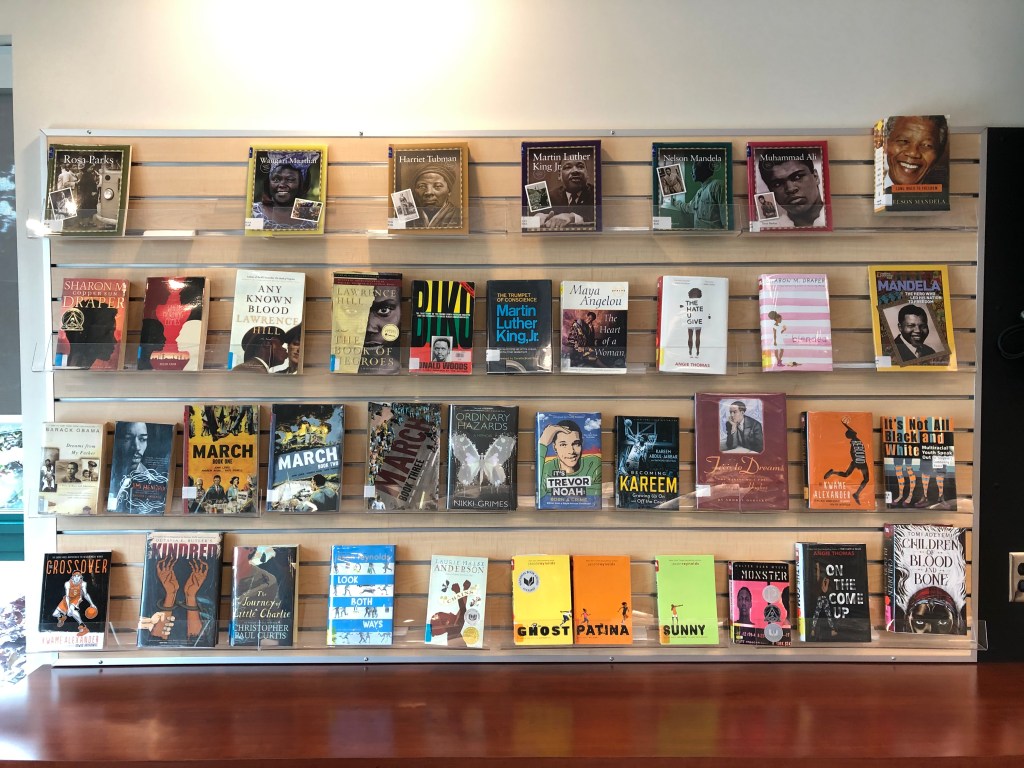
This also helps to build “Cultural Literacy” throughout the school, one of the standards for Canadian school libraries (CLA 17); it encourages open-mindedness and cultural awareness for the entire school community. After all, isn’t one of our goals as educators to create more empathetic citizens who consider various perspectives beyond their own? In Jason Reynolds’ talk on the significance of libraries for the American Library Association Annual conference from 2019, he makes the analogy of the body as a library. And that libraries are “warehouses where we build human libraries”, where each person has their own “reference desk” in their minds and in their hearts that they can use whenever they need. As Reynolds explains, this only works if we share each other’s narratives and “store” them within ourselves. He says,“I feel […] so grateful to walk around with narratives that are not like my own but still share parts of me. It’s an incredible feeling to know that I hold someone’s stories that I can then use to be more empathetic”. Introducing students to new and culturally diverse narratives can positively impact their overall view of others and create more understanding. In addition, displaying work from student or local artists contributes to a sense of community and ownership over the space; while encouraging speakers to come in, especially in conjunction with concurrent writer’s festivals, sparks interest in local writers and leaders.
In the end, the school library learning commons, like many libraries that have come before it, is a central gathering place and hub for student communities. It is a place for staff to come together to collaborate, for students to learn skills to become lifelong learners, to build a reading culture, and to celebrate diversity. Being open-minded and working as a team to find creative solutions to issues (to suit your budget!) will help bring your vision to life.
Works Cited
Beirut, Michael. “How to Design a Library That Makes Kids Want to Read.” YouTube, uploaded by TED, 23 June 2017, http://www.youtube.com/watch?v=YsA_JTeHJ6A. Accessed 15 Sept. 2020.
(CLA) Canadian Library Association. Leading Learning: Standards of Practice for School Library Learning Commons in Canada. 2014. http://llsop.canadianschoollibraries.ca/wp-content/uploads/2016/09/llsop.pdf. Accessed Sept 15 2020.
Hayes, Terri. “Library to Learning Commons: A Recipe for Success.” EdCan Network, 23 Jan. 2014, http://www.edcan.ca/articles/library-to-learning-commons/. Accessed 15 Sept. 2020.
Reynolds, Jason. “ALA Annual 2019: Jason Reynolds on Libraries within Us.” YouTube, uploaded by American Library Association, 22 June 2019, http://www.youtube.com/watch?v=KzpgNAZ8MQE&feature=emb_logo&ab_channel=AmericanLibraryAssociation. Accessed 24 Sept. 2020.
Smith, Pam Sandlian. “What to expect from libraries in the 21st century: Pam Sandlian Smith at TEDxMileHigh.” YouTube, uploaded by TEDx Talks, 16 Dec. 2013, http://www.youtube.com/watch?v=fa6ERdxyYdo&ab_channel=TEDxTalks. Accessed 24 Sept. 2020.
 LIBE Diploma Blog 2020