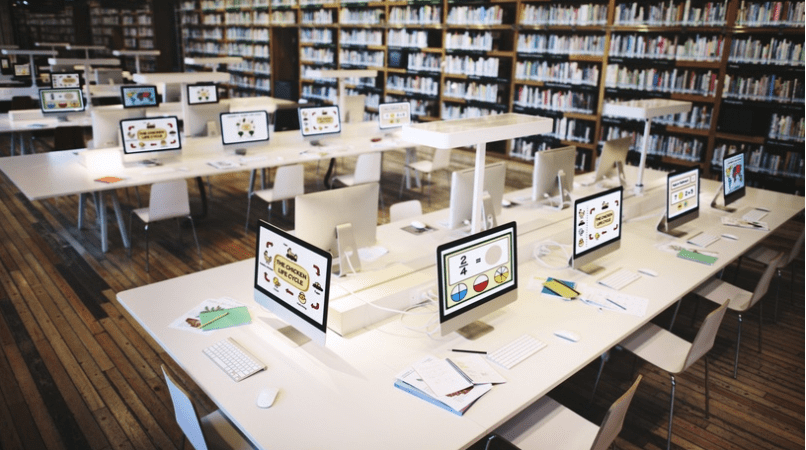
Source for image: eLearning Industry
Reflections on Theme 3: Reference Materials
Introduction
In this section of the course, we examined more closely the different types of references academic libraries offer. It reiterated the overwhelming sources of information available to students and staff, many of which are digital and free of charge. While these sources remind us of the paramount role of the teacher-librarian in guiding information literacy and strong knowledge acquisition, it also emphasizes the variety of guidelines and established resources that already exist, well vetted by experts who have come before us.
The Analogy of Dictionary Writing, the Evolution of Language, and the Fluidity of Information Consumption
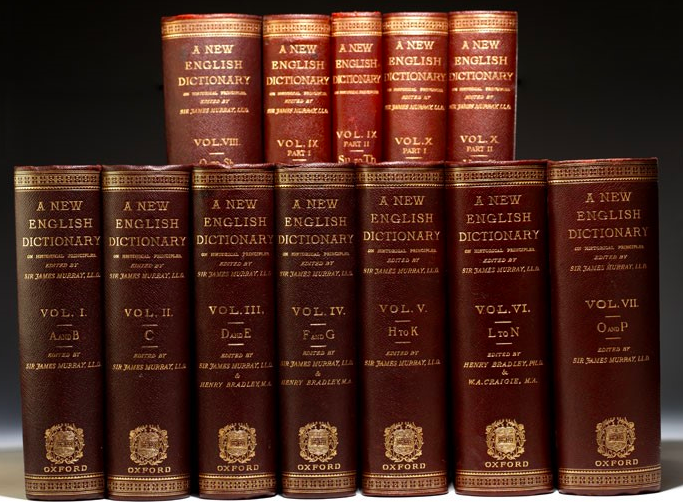
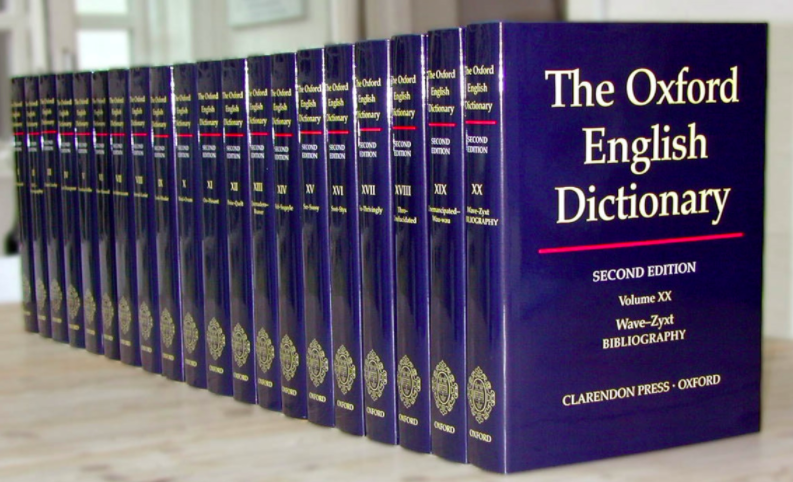
Dictionaries and thesauri are often overlooked as reference sources, but provide the basic language and style skills needed to both interpret and write about research topics. The challenges of writing and publishing dictionaries are similar to the obstacles faced by librarians tasked with managing references and endless information.
The History of the OED (Oxford English Dictionary), briefly summarized in this online article highlights the unexpected breadth and time commitment needed to centralize definitions and usage of the English language. It took 50 years to come up with ten volumes of data, with various teams of people contributing to see the dictionary project to its completion in 1929 (Oxford University Press).
Similarly, a teacher-librarian’s work does not exist in a vacuum. We are professionals who work with a large team of teachers, administrators, and district leaders. We also rely on:
- well-established publishers and guidelines, such as ERAC’s Evaluating, Selecting, and Acquiring Learning Resources: A Guide and Achieving Information Literacy: Standards for School Library Programs in Canada
- general indexes, such as EBSCO and Information Access Company
- reputable encyclopedias like World Book, Britannica, and Canadian Encyclopedia
- Academics like Ann Riedling et al., who have published a goldmine of evaluation guidelines for reference sources in their textbook Reference Skills for the School Librarian
- experienced colleagues and course instructors who share reference sources, such as Aaron Mueller at UBC
Teams of people have worked long before us, and continue to work alongside us, to identify expert resources (something that is now more important than ever, when people are consuming most of their information online). Just like dictionaries are the building blocks of language, these established practices and guidelines provide the legs on which teacher-librarians can stand when making decisions for their reference collections.
In addition, the Oxford English Dictionary states as one of its challenges: “An exhilarating aspect of a living language is that it continually changes. This means that no dictionary is ever really finished” (Oxford University Press). This relates to our modern information network, which is constantly updated and fluid; from dictionaries to encyclopedias; from indexes to maps; from online banking to cryptocurrency, the way we administer, process, and value information is continually evolving.
In this video, David Evans, editor of Language and Identity: Discourse in the World, discusses the “changing nature of the English Language”. The video isn’t flashy, but Evans makes some good points about the evolution of language. In the chart below, I compare his ideas on language with the changes to information consumption:
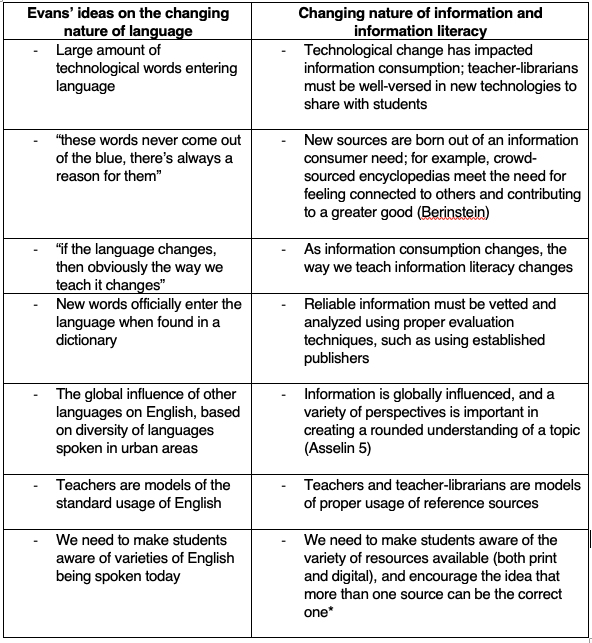
*This reminds me of Noah Webster, who came out with his dictionary in 1806
to show that American English was “not inferior, only different” from British usage (Mueller, Lesson 12).
Conclusion
In the same way that dictionary publishers are required to continually examine new words, making calculated decisions based in good research, teacher-librarians must constantly evolve their practice, researching and understanding new technology and sources of information. One of our goals as teachers is to instil a love for lifelong learning in our students; we too must participate in new learning opportunities to stay current and keep our reference services relevant. Taking advantage of established professionals and literature; carefully selecting online resources like databases and indexes; and participating in conferences like those organized by BCTLA, are important parts of this continual growth.
Works Cited
Andrews, Mark. “David Evans on the changing nature of the English language”. YouTube, 11 April 2011. Accessed 24 March 2020. https://www.youtube.com/watch?v=nxatwGeVnvU
Asselin, Marlene et al. Achieving Information Literacy: Standards for School Library Programs in Canada. Canadian Association for School Libraries, 2006. Accessed 24 March 2020. http://accessola2.com/SLIC-Site/slic/ail110217.pdf
Berinstein, Paula. “Wikipedia and Britannica: The Kid’s All Right (And So’s the Old Man)”. Information Today, Inc. March 2006. Accessed 24 March 2020. http://www.infotoday.com/searcher/mar06/berinstein.shtml
Gutelle, Sam. “‘YouTuber’ is now a word in the Oxford English Dictionary”. tubefilter, 27 December 2016. Accessed 24 March 2020. https://www.tubefilter.com/2016/12/27/youtuber-oxford-english-dictionary-oed/
Mueller, Aaron. “Lesson 12: Dictionaries and Thesauri; Almanacs, Yearbooks, and Handbooks”. LIBE-467-63C, University of British Columbia, 2020.
Oxford University Press. “History of the OED”. Oxford English Dictionary: The definitive record of the English language, Oxford University Press, 2020. Accessed 24 March 2020. https://public.oed.com/history/#how-it-began
Riedling, Ann Marlow, et al. Reference Skills for the School Librarian: Tools & Tips, Third Edition. Santa Barbara, Linworth, 2013.
 LIBE Diploma Blog 2020
Excellent reflection! I really appreciated your connection with the evolving language, dictionary development and all the reference resource reminders throughout your post. It was a solid tour through your key learning, new understandings, some goals going forward and connections to our course, textbooks, publications and personal learning network. A very honest, authentic reflection on the changing nature of our roles, responsibilities and opportunities going forward. Thank you for this wonderful look back.
LikeLike
Hi Sophie, I like how you put the comparative information in a table, it made it very clear to me in my current state of mind. I also appreciate how you still connect to all of the other ways that TLs make informed selection decisions constantly.
LikeLike