
Inquiry Blog Post #2
As a teacher of high school humanities courses, I often find the massive information consumption for lesson delivery to be quick-paced and overwhelming; so it’s hard to keep track of what I’ve accomplished in the classroom for student engagement and inspired learning. I have spent the past few days reflecting on the role of ICT in my classroom. This has left me feeling a bit inadequate, and questioning why I don’t use it more frequently, or why I haven’t invested in learning and trying new things. But then I remember that – yes! I have used new technology and shared it with my students. Kahoots for content review; Pixton for comic strips; Visme for graphic organizers; Google Classroom for resources and assignments; GooseChase for a scavenger hunt about Macbeth; using social media to create fictional character profiles. I’ll admit that the list is small, and that I have lots of room to grow, but I want educators to remember that you are doing great and that trying to incorporate ICT in small ways into your classroom can be easier than you think. And sometimes when we stretch ourselves just a little bit, it can make a big difference in how we see things. None of this takes away from all the other “on the ground” awesome stuff you are already doing, and of course we want to hang on to those great strategies we already have in our curriculum planning banks.

In this second inquiry for LIBE477, students were asked “to explore how you can continue to develop your own skills, pedagogy and professional development on your own, back in your own library/classroom and environment” (McNee). The first concept I would like to consider is a suggestion from the chapter titled “Rethink Teaching” from Will Richardson’s Why School?: How Education Must Change When Learning and Information Are Everywhere. One of six suggestions he makes is to “Be a master learner” (Loc 455). As an introduction to this section, Richardson compares doctors with educators, stating that “50 percent of all medical knowledge becomes obsolete in five years” (Loc 356). This means that getting treatment from a doctor who isn’t continually learning may not yield the results you would expect from a trained professional. The same line of thinking applies to educators, who need to “constantly unlearn[] and relearn[] their practice” (Loc 356) in order to meet the changing needs of society and technology.
In this way, Richardson posits that “What’s needed for reading and writing literacy is evolving far beyond traditional definitions. In fact, by modern standards, most of us are illiterate” (Loc 542) when it comes to 21st century standards of learning outlined by the National Council of Teachers of English (NCTE) (Loc 177). These include “a proficiency with the tools of technology” and the ability to “design and share information for global communities and to meet a variety of purposes” (Loc 177). It follows that if students are required to meet these standards to succeed in modern life and workplaces, then teachers must also be capable of modelling these proficiencies. Richardson makes an analogy between the abundance of information offered by technology and libraries: “If we’re to develop learners who can make sense of the whole library, we must already be able to do that ourselves. In other words, the adults in the room need to be learners first and teachers second” (Loc 473).
The concepts of lifelong learning and continual professional development have been a significant part of my teacher education and career. However, I think with the busy-ness of trying to find a work-life balance, we may get stuck in our usual pathways and lessons as we attempt to complete curriculum expectations with what almost always feels like limited time. So, what changes and commitments can I make to continue to “be a master learner” and develop my pedagogy, with specific reference to ICT?
One of the best ways to learn is to READ. Read, filter, read, filter; find pathways to experts and new information on a regular basis. In Richardson’s book, he suggests other authors and educators who are making great strides in educational technology and inquiry. It’s easy to gloss over those sections to get to the more meaty, quotable stuff as a researcher – but wait! That’s the time to put on the breaks, get those names down and start researching them. One of the authors he mentions is Cathy Davidson who wrote Now You See It, published in 2011. After reading a sample on the Kindle Cloud, I decided to purchase it; this is something I wouldn’t typically do because for some reason I hesitate to spend money on myself, which includes buying books. However, this is one of the areas that I think needs to change for me. Of course, in a non-Covid time, I would see if I could get the book from a local library, but I also think that sometimes adults underestimate the power of professional learning from the experts, and that spending money on these things is a major debate for many people. I even hesitate to spend the money given to me by the district for professional materials and development. It makes no sense. So I’m going to work on changing my thinking on that and take advantage of the things that are literally at my fingertips.
In Davidson’s book, she focuses new learning strategies on “attention blindness” (6). She explains that “Because focus means selection […] it leaves us with blind spots, and we need methods for working around them. Fortunately, given the interactive nature of most of our lives in the digital age, we have the tools to harness our different forms of attention and take advantage of them” (2). This is the photo negative if you will, of the research I did on the detriments of multitasking, because this talks about taking advantage of the distractions, calling them forms of attention instead. This reiterates a personal shift in my own thinking: as we remain open minded and willing to see things in a new way, we are more capable of coming up with creative solutions when we recognize our “blind spots”. Davidson aims to show how we can use ICT to improve learning and creation, explaining that “The age we live in presents us with unique challenges to our attention. It requires a new form of attention and a different style of focus that necessitates both a new approach to learning and a redesign of the classroom and workplace” (10). I look forward to reading more of Now You See It, and committing to reading more about new pedagogy as I continue my development as a role model for others. I would also like to share good professional development titles with other teachers and perhaps start a learning library for staff, and in this way keep myself accountable to growth.
Another person Will Richardson introduces to the reader is Shelley Wright, an educator who transformed her teaching and now has an “inquiry-based, technology-rich approach [where she learns] along with her students” (Loc 381). I found her on Twitter with the handle @wrightsroom, and clicked on a tweet that linked to Katie Martin’s blog; Martin is also an educator who promotes expert tech integration in the classroom. The article is called “Let’s Talk About Cell Phone Bans: Should We Limit Access or Teach Responsibility?” – and this article couldn’t be more fitting for not only my learning in this course, but for the great debate that has been going on at my school for years. But this was only accessed after taking a route with several “clicks” to get to the right place. This is the sort of thing I can model for my students when they are doing their own inquiry-based projects: sometimes the path you start on is not the path you end up on, and that can be really rewarding.
In her article, Martin states “What if we instead model and share our strategies and struggles to focus and prioritize with the many distractions we face? Many teachers are begging for support, resources, and strategies for how to engage, empower and connect with students? Can we try teaching responsible use and how to manage distractions (that will be a valuable life and work skill) instead of banning things in schools?” It is not only reassuring to see that many educators are struggling with the same things, but also reaffirms why professional development in ICT is so important at this stage of education, and why it should be a priority for districts and schools as they plan teacher-learning time. I also like that Martin focuses on the idea of modelling, not only successes, but also the struggles or roadblocks we may face as teachers trying to use new technologies.
There is often an underlying sense of embarrassment when you are unable to quickly resolve tech issues in the classroom. I don’t know if this harks back to my days of hauling in the massive “media carts” with a projector, speakers, and about a dozen wires to contend with, where 9 times out of 10, something would go wrong. Now we have HDMI cables! Now we have built-in projectors! (Yes, I recognize we are a very lucky district to have the funding for these things, and my hope is that this will be a priority for government spending to increase functionality and ease for educators).
And yet, there are still rings of “Miss, you know you can just press the spacebar and the video will pause, right? That drives me nuts when teachers don’t do that!” And with all of the “Put your phones away” and “Get off your phone” they hear from me, when I surreptitiously get out my phone to use Tiny Scanner to turn textbook pages (less than 10%, don’t worry copyright friends) into pdfs to post on Google Classroom, I feel like a kid sneaking candy while my parents are watching TV in another room. “Don’t worry, everyone! I’m just uploading the textbook pages onto Classroom, I’m not actually using my phone!”
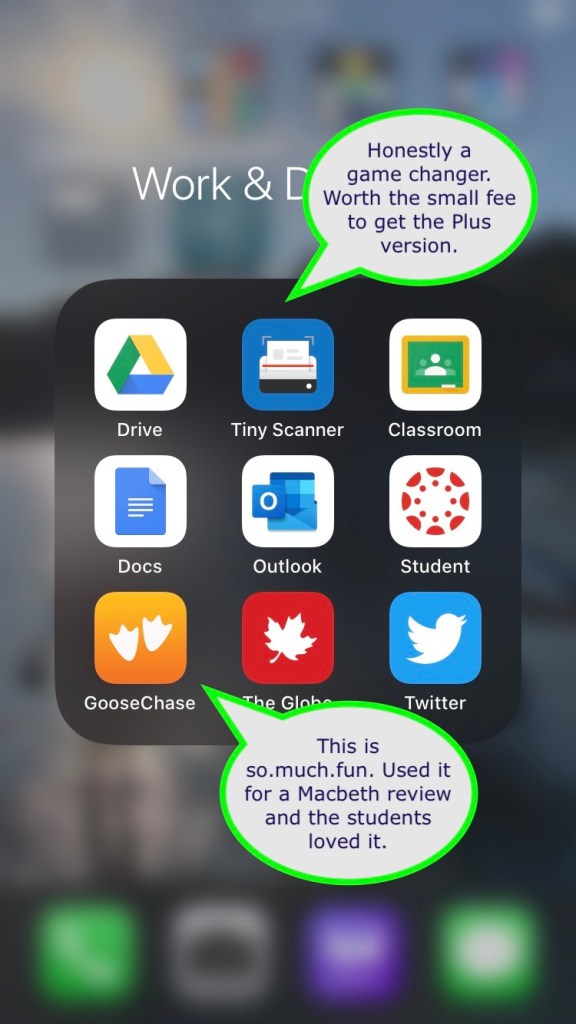
But the question is, why do I feel like I have to hide using my phone for professional purposes? We have gone so far in saying how detrimental and distracting phones are, yet there is some good reasoning out there to say that teaching management of phone use is more effective than banning it altogether. Richardson notes that with his school-aged son “[…] school is the only place in their lives where they can’t use the technology they carry around in their pockets and backpacks to answer questions” (Loc 326). Similarly, Martin aptly states that: “We can’t continue to approach a new era with old behaviors, ignoring or banning the technology that is so integrated into our daily lives.” Perhaps there is a middle ground where I don’t feel guilty having my phone out to do work, and neither do the students. And I do allow for phone use to look things up or read news articles if students don’t have another device at school with them. Although they are meant to BYOD, for various and obvious reasons, this isn’t always possible; and it is actually not possible to get a full class set of laptops, even in a very well funded school.
Even more important is that our students are such an excellent resource for new technologies. When given the opportunity to create their own visual to demonstrate understanding of course content, I often come across students using great websites to create their graphic organizers. I always compliment them on their creativity and skills as individuals, but I think it’s time to take it a step further and make a living document, or some kind of shared space, where students can contribute apps and programs they find useful for completing school work. This could be accomplished through informal conversations in the classroom, where the teacher makes a list of apps and tools, and perhaps the students could be the ones to annotate them, explaining their uses, and also potentially, their drawbacks. After all, we want them to be thinking critically about the resources they are using as digital citizens. As a final goal, I would like to use a new technology per unit or major assessment, checking out sources like Explain Everything and Flipboard, titles that have come up in my recent research, with input from students too.
But I can handle minor embarrassments, and often reach out to students to help with tech issues by attending a little to their egos (while acknowledging my ‘old age’) – “Okay, who’s a tech expert who can help me with this?” Maybe it would be nice though, to actually be the tech expert in the classroom! There is a hesitation as we age to learn new things, but I have had many good role models who late in their careers were applying new technology and teaching methods. So I’m up for the task! I will admit that I hesitate on things like the Kindle reader as a standard method of textbook or educational reading. Before this course, given the choice, I would buy the textbook (I like to write in the margins, underline things, I am an English teacher, after all), but do you know how EASY it is to find the quote you want in the Kindle Cloud Reader?! It’s a simple Control-F, and a bit of discerning which quote is yours, and boom! Mind. Blown. It makes research life so much easier (although I would love a copy and paste option there too – does anyone know how to do that with Kindle text?). Sometimes small changes using technology can make a big impact on getting things done.

If we spend a little time figuring out our own “blind spots” around learning and technology, we can start discovering ways to improve digital literacy for both ourselves and our students. Reading widely, setting achievable goals, talking to other educators, and taking small steps to integrate technology in our units and activities demonstrates to our students that we are lifelong learners. Isn’t that the main point of it all, anyways?
Works Cited
Davidson, Cathy N. Now You See It: How Technology and Brain Science Will Transform Schools and Business for the 21st Century. Kindle Edition, 2011.
Martin, Katie L. “Let’s Talk About Cell Phone Bans: Should We Limit Access or Teach Responsibility?” WordPress, 25 March 2019. Accessed 23 July 2020. https://katielmartin.com/2019/03/25/lets-talk-about-cell-phone-bans-should-we-limit-access-or-teach-responsibility/
McNee, Darcy. “Module 4: Developing your own ICT skills and Pedagogy”. LIBE477B-93S, University of British Columbia, 2020.
Richardson, Will. Why School?: How Education Must Change When Learning and Information Are Everywhere. Kindle Edition, 2012.
Source for Featured Image: Coates, Sheree Alicia. “5 Reasons to Allow Students to use Cell Phones in Class”. WordPress, 4 August 2015. Accessed 23 July 2020. https://shereecoates.wordpress.com/2014/08/04/5-reasons-to-allow-students-to-use-cell-phones-in-class/
 LIBE Diploma Blog 2020
Another thoughtful and reflective post that documents your thinking, strategies and plans for continuing to develop your ICT skills. I appreciate your insights. This quote in particular stood out to me – “sometimes the path you start on is not the path you end up on, and that can be really rewarding.” You have shared, linked and modelled some strong tools which enhance your post. I haven’t tried this, but have heard good things about this chrome extension which allows you to copy and paste from Kindle…https://chrome.google.com/webstore/detail/kindle-cloud-copy-paste/ogeaillnghcjkpiiobcpkcjlbegkfogf?hl=en
LikeLike
Thanks for the feedback and the suggestion for the Chrome extension! I’ll check it out.
LikeLike
Hi there,
I really enjoyed reading through your thoughts on modelling technology use in the classroom. When you discussed how often teachers shy away from using their phones in class for professional purposes, or are nervous to try new things because they aren’t the “expert” i think you made an important point. Our students need to see those things, they need to see teachers use their phone briefly for a professional reason at a responsible time and then put it away, this models the type of behaviour we should expect from them. When they see us try something new, struggle a bit but not give up, retry, and ask questions until we figure it out we are again modelling the type of behaviour we want to see from them. If students can see these behaviours from us as teachers I think we are more likely to have a chance at teaching them how to use technology effectively in their own lives outside of school.
LikeLike
Thanks for the comment, Julia! I like that idea very much – that students “need to see teachers use their phone briefly for a professional reason at a responsible time and then put it away, this models the type of behaviour we should expect from them” – it’s very true! I will draw attention to it as a “teachable moment” next time I use my phone for educational purposes. – Sophie B.
LikeLike