
Inquiry Blog Post #1
After my first year of university, I switched my major from Science to Arts. Although I had succeeded in the sciences in high school, and had a passion for some of the areas of study, the rigorous nature of that first year program (and perhaps a bit of a lack of discipline living away from home for the first time) and the feeling that I was running on a treadwheel of memorizing facts for exams, led to a lot of frustration and “failures” to achieve what I was accustomed to.
There was a lack of engagement for me, and the one of the only places where I felt truly invested was my “Survey of American Literature” course, the only elective spot available to me as a first-year science student. The reason I felt invested was because I felt more joy when reading the texts for the course; literature had always been an escape for me, but now it was also a place of great learning about history, culture, and social issues. And I thought to myself: how do I want to spend my hours and years of university study? Wouldn’t I be happier spending time on something that brought me joy? Something I was passionate about?

Given this background on my learning, it is a bit embarrassing to admit that I have a lot of room to grow when it comes to fostering a reading culture in my classroom. I teach English and Social Studies at the secondary level, two courses where reading is central to learning. In my English classroom, every year begins with a visit to the school library so that students can pick their own silent reading book. Our teacher-librarians do an incredible job of doing an “orientation” to the reading resources available, and always pull out a number of titles they know appeal to that grade-level. They are knowledgeable and make connections to popular culture. I typically can’t help jumping in and giving opinions on book titles, and then make a point of walking around with students who are having difficulty choosing a silent reading book. This is one of my strengths – passing along a passion for reading, and also making students feel seen by providing them with specific suggestions for a book. “I think you’d really like this” is such a simple phrase, but can go a long way in how a student feels that they are seen as an individual in your classroom.
One of the ways I get to know students at the beginning of the year is through a questionnaire that they fill out on their interests and what genres they like to read and write in (I teach a number of creative writing courses). This helps me guide them when we go to the library, but also informal conversations on the spot about topics they like is a great way to connect with them.
In my research on fostering reading culture using technology, I found an article by Monica Burns titled “Cultivating a Love of Reading in the Digital Age: Four tips for taking advantage of apps and other tools to encourage students to read”. The first tip is to “Learn about their interests to give them a choice in what they read”, which is typically done through a paper questionnaire in my classroom. However, she presents a different, technological way to engage students in sharing their interests. This can include using Kahoot to find out what students enjoy, or to “use virtual exit slips to get a feel for topics students would like to learn more about” done through Spark Post. I have used an exit “ticket” in the past, but I really like the idea of using technology to have students answer questions and share their interests.
Another suggestion Burns provides is to “Provide access to a wide variety of texts”, which I completely agree with. Again, we have a great team in the school library, who do an excellent job of providing a variety of reading materials that represent different cultures, social issues, perspectives, reading levels, etc. However, students are often drawn to reading the same type of literature over and over. In a study done in Nigerian schools on promoting reading culture, published in Library Philosophy & Practice in October 2018, it recommends that students should “read widely” and that “students [should] read outside their preferred genres” in order to “build a wide vocabulary and broad background knowledge” (34). This is something that both English teachers and teacher-librarians can promote.
| Four Tips for Taking Advantage of Apps and Other Tools to Encourage Students to Read (from Burns) |
| 1. Learn about their interests to give them a choice in what they read. |
| 2. Provide access to a wide variety of texts. |
| 3. Find mentor readers to inspire them. |
| 4. Foster a community of supportive and encouraging fellow readers |
Furthermore, in a case study done in Singapore on reading in six secondary schools, published in 2017, they explain that good readers are more motivated to read since they are better at decoding and gaining information from a variety of texts. The authors state that “Besides gains in reading comprehension, vocabulary growth, spelling ability, grammatical usage and writing style, students who read well are able to access more texts and knowledge through wide and varied reading (Cunningham and Stanovich, 1998). This ‘information capital’ (Neuman and Celano, 2012) that students acquire through extensive and wide reading leads to acquisition of more knowledge, including those required for doing well in academic subjects” (335). This seems obvious that good literacy begets good literacy, but I never made the link between silent reading, which I always viewed as for pleasure, and the ability to succeed more widely on content-based reading for other subjects.

I always start the year strong with silent reading in my English classes. Students typically get 15-20 minutes at the beginning of each class to silent read, with some sessions extended longer for them to really “get into” what they are reading. One of the drawbacks of this is that some students don’t see the value in silent reading, so they are more inclined to be late and miss reading completely, not viewing it as learning time. This made me reconsider and place it at the end of the lesson instead, but oftentimes we get so caught up in that day’s learning that we run out of time for planned activities, let alone silent reading. This is one of the challenges I would like to work on, especially given that once we get into the novel study, silent reading of personal books is replaced by aiming to get through the novel.
Last year, I had a contest in my English 10 class to see who could read the most books by the end of June. Although I didn’t do a very good job tracking it throughout the year, I went on the honour system with an end-of-course questionnaire which included a question on how many books they had read since September. The top three students got a prize – a classic book or a journal to write in (both found for affordable prices at Indigo). The students were so grateful and surprised I had followed through with the contest, and it was a very touching moment to recognize these readers in front of the class. However, I’m not sure how well this addressed my students who struggle with literacy, and may have reinforced already strong readers (which is also great, but I would like to encourage all levels of readers to engage in a positive reading culture).

In the article “Using Technology to Cultivate a Culture of Readers” written by Katie Stover Kelly and found on Literacy Now, the author suggests using Biblionasium to track titles read by students. Once the teacher has set up the digital classroom, “each student can add books to their virtual bookshelves” (Stover Kelly). This is a great way to integrate technology into my previous contest that recognizes reading for pleasure; yet, I would like to see something like Biblionasium for high school students, since it seems a bit young for them. Goodreads is likewise mentioned by Katie Stover Kelly, but I’m not sure how user-friendly it is for the classroom setting, since the author mentions: “Many adults use Goodreads to track reading lists, rate books, write reviews, and connect with other readers for book recommendations” (emphasis added). It would not be managed by an educator in the same way as Biblionasium, so I would be curious to learn more about the application of Goodreads in the classroom.
One of the most significant ways to develop a great reading culture in schools is through leadership. Administrators who prioritize library use and reading widely are invaluable to promoting literacy. In a study of library use in Nigerian schools from the article “The Role of School Libraries in Promoting Reading Culture among Secondary School Students: A Case Study of Federal Government College, Jos.”, it recognized that “[t]he school management should integrate school library programs into the overall school curriculum. They should set aside time for independent reading/library periods. Time for reading independently doesn’t just happen” (345). The last sentence resonated with me, because I think it’s true that integrating reading time into the daily curriculum will promote overall literacy. In addition, Monica Burns states that “[e]ven in a world with all this technology, it’s still important to allow time for reading in class […] Setting aside time on the schedule shows students you value their reading lives and encourages them to spend time in new books and old favorites”. These recommendations make it even more important to stick with the silent reading as part of daily lessons, and reiterating to students the significant learning that takes place during this time.
| Recommendations from “The Role of School Libraries in Promoting Reading Culture among Secondary School Students” (Nigerian study) |
| 1. Teacher librarians should encourage students to read widely. |
| 2. Host book clubs for students and parents. |
| 3. Support author visits. |
| 4. Integrate school library programs into the overall school curriculum (led by school management). |
| 5. Sponsor a young author conference. |
Tyson, K. (2013). 25 ways schools can promote literacy and independent reading. Retrieved from: http://www.learningunlimitedllc.com
Going back to the Singapore example discussed in “Building a Successful Reading Culture through the School Library: A Case Study of a Singapore Secondary School,” the authors discovered that one school in particular had done an expert job at creating a reading culture in the school, where “68.9% of the students enjoyed reading” (345). They found “that most students read for pleasure (e.g. reading is my hobby, I read for enjoyment, I read for relaxation). [And that s]tudents also saw reading as part of their learning and were happy with the fact that reading was encouraged rather than enforced in school. Despite the lack of monitoring by school staff, students were often seen reading and shared that they saw reading as a legitimate and valuable activity to engage in” (345). This is in direct contrast to the Nigerian case study that found that “students depend chiefly on textbooks, (88.6%), and their teachers (lecture notes) (70.9%) and novels (78.3%) as the most important source of reading material. This finding affirms […] that students read only to pass examinations. They don’t [see] poetry, comics and newspapers as [being] important” (32). I think this statement can apply to many schools across North America too, as I have personally witnessed the groans over poetry, and the lack of interest in reading the news. In this case study, they portion some of the blame on “[t]echnology and the rise of social media. […] [Y]oung adults spend hours watching televisions, and chatting on social sites at the detriment of reading” (1). The purpose of the study was to promote reading for pleasure through a strong school library and by promoting reading in the community.

The successful school reading culture in Singapore would not have been possible without great leadership within Quest secondary school. There are four recommendations for promoting a reading culture in the article by Loh et al., and the final one is titled “Building an ecology for reading” (344). This means that in order “[t]o build a reading culture, there needs to be an ecology of reading within the school with the principal leading the way (Francois, 2015). The emphasis on reading in Quest was driven by the principal, an avid reader himself, and supported by the staff” (344). This principal modeled reading as a significant part of the learning community, and encouraged not only students, but staff to read more frequently. Loh states that “He was an example to his staff, often sending out readings through Twitter to selected staff to encourage them to read to learn more about their content area or to inspire them in life and in work” (344).
| How to Promote a Strong Reading Culture through School Libraries (from the Singapore Case Study) |
| 1. Make books visible. |
| 2. Create programs to excite readers and non-readers. |
| 3. Design conducive spaces for reading. |
| 4. Build an ecology for reading. |
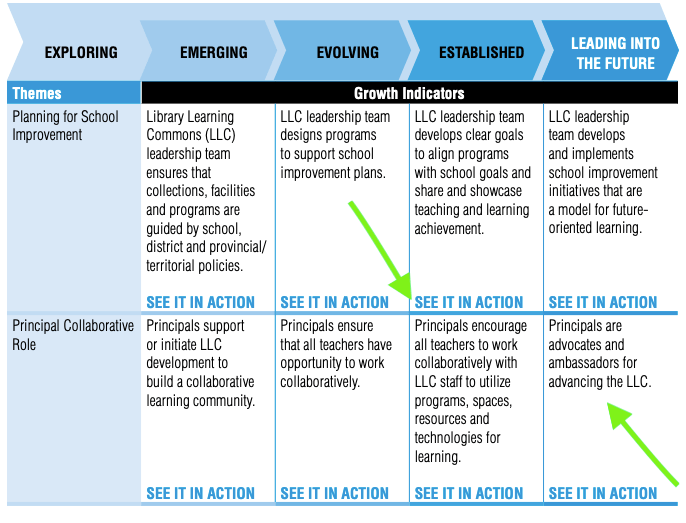
In the Canadian Library Association’s Leading Learning: Standards of Practice for School Library Learning Commons in Canada, one of the foundational rubrics “Advancing the Learning Community to achieve school goals”, includes “Principal Collaborative Role” as one of its themes. An Established library learning commons will have “Principals [that] encourage all teachers to work collaboratively with LLC staff to utilize programs, spaces, resources and technologies for learning”, while “Leading into the Future” sees “Principals as advocates and ambassadors for advancing the LLC” (13). At Quest in Singapore, the principal was definitely a leader of the future through positive modelling to promote a strong reading culture in his school.
In my own small ways, I think that my passion for literature and reading comes across to my students in the classroom. One of my many great memories of teaching English is being able to read aloud with my students, stopping at significant moments, discussing our reactions, and making connections to our own lives as well as local and global issues. The Marrow Thieves by Cherie Dimaline is one of my favourite read aloud texts since there are so many beautifully written passages, in addition to thought-provoking and very surprising twists and turns. I read with gusto and often exclaim: “Oh my gosh, isn’t that just crazy?! Isn’t that just the best?!” I don’t like to have students sit passively for too long in the classroom (I typically aim to plan the lessons in three parts), but some days we get into the novel so thoroughly that when I ask if they want to keep going, there is a resounding “Yes!” This has to be one of the best moments when teaching a group of 15-year-olds who will happily be read to.

My aim would be to harness this positive energy into their own reading, and to encourage them to read more for pleasure both in and out of the classroom. For many of them, they would prefer to write their own stories rather than read, which of course I am happy to encourage them to do, but I think some of them fail to see the link between reading widely and writing successfully. And how do we compete for their attention when there are so many bite size TikToks and YouTube videos to consume? How do we get the message across that reading is the very foundation for success in all the other aspects of their lives? Finding what they love and feel passionate about is definitely a good place to start, and for this science-turned-english-literature nerd, I hope I can model reading as lifelong learning to my students.
Works Cited
Burns, Monica. “Cultivating a Love of Reading in the Digital Age: Four tips for taking advantage of apps and other tools to encourage students to read”. Edutopia, George Lucas Educational Foundation, November 2017. Accessed 21 July 2020. https://www.edutopia.org/article/cultivating-love-reading-digital-age
CLA. Leading Learning: Standards of Practice for School Library Learning Commons in Canada. Canadian Library Association, 2014. Accessed 21 July 2020. http://llsop.canadianschoollibraries.ca/wp-content/uploads/2016/09/llsop.pdf
Danladi, Diyoshak Rhoda, and Yohanna Rejoice Soko. “The Role of School Libraries in Promoting Reading Culture among Secondary School Students: A Case Study of Federal Government College, Jos.” Library Philosophy & Practice, Oct. 2018, pp. 1–40. EBSCOhost, search.ebscohost.com/login.aspx?direct=true&db=lls&AN=133865535&site=ehost-live&scope=site.
Loh, Chin Ee, et al. “Building a Successful Reading Culture through the School Library: A Case Study of a Singapore Secondary School.” IFLA Journal, vol.43, no. 4, Dec. 2017, pp. 335-47, DOI:10.1177/0340035217732069. Accessed 21 July 2020.
Stover Kelly, Katie. “Using Technology to Cultivate a Culture of Readers”, Literacy Now, International Literacy Association. Sept. 2017. Accessed 21 July 2020. https://literacyworldwide.org/blog/literacy-now/2017/09/01/using-technology-to-cultivate-a-culture-of-readers
 LIBE Diploma Blog 2020
I really enjoyed reading through your thoughts and ideas! I think the promotion of reading can be difficult, especially in a high school setting, because there seems to be a preconceived idea that reading isn’t fun or enjoyable and is only something to be done in school for a grade in a class. I think a lot of the ideas and suggestions you have provided through your analysis of the sources you found are great starting places for teachers and teacher librarians in promoting reading in their schools.
When you discussed the two case studies and the contrast found between the two groups, you quoted the following, “they portion some of the blame on “[t]echnology and the rise of social media. […] [Y]oung adults spend hours watching televisions, and chatting on social sites at the detriment of reading” (1).” I think educators often default to this argument when discussing reading, looking at technology and social media as a bad thing. I would like to suggest we start to look at it as simply another form of text. I think we would all be surprised how many students spend hours reading… on their phones. This is not to say that we shouldn’t encourage them to pick up a novel or comic book, there is tremendous value there, but rather to consider the world they live in and acknowledge that their engagement and reading of social media posts is developing their literacy as well, just in a different way!
-Julia
LikeLike
What a thoughtful, well researched and well-written post filled strong ideas on fostering a reading culture. You have shared a number of excellent resources, ideas and strategies here. I resonate with the importance of having students be recognized as individuals and I am eager to try some of the strategies you suggest such as digital exit tickets. I also appreciate your comment about having students understand the “link between reading widely and writing successfully.” Thanks for posting this to Twitter so that your great ideas can be shared!
LikeLiked by 1 person
Your post really inspired me to connect with the incoming grade 8 students right off the bat in September. Prior to them coming into the library for orientation, I would love to have them fill out a short survey or complete a Kahoot on the genres they like to read (as you suggested) or what they want to learn more about (great way to get some non-fiction in there!), so that I can then create a couple of displays showcasing books in that genre. I also discuss the importance of silent or “engaged” reading (as the Richmond School District calls it) in my blog post. Making the time to read is something I had to relearn for myself about 4 years ago even though I was an avid reader throughout high school, and I have not looked back since. As a teacher, I can easily get bogged down by the piles of marking and the numerous emails, but I have to remember why I got into teach (a love of learning), and if I nourish that love of learning, it will only make me a better teacher. I will definitely check out Cherie Dimaline. Thanks! – Rachael Lew
LikeLiked by 1 person
Hi Rachael. Thanks for the feedback! I think you will enjoy Cherie Dimaline. Empire of Wild is awesome, but is more an adult read than a young adult read – it’s really kind of out there in terms of narrative style, but I love it when novelists go outside the normative novel structure and do it well. I have really tried to make reading for pleasure a priority these days, and have read some really great titles (from Reese’s book club!) like Where the Crawdads Sing by Delia Owens, which reminds me in a lot of ways of Crow Lake by Mary Lawson (a Canadian author). They are both great summer reads! – Sophie
LikeLike
Your blog post is full of great ideas and resources for creating a culture of reading in schools. Thank-you for sharing your findings and tying it into your personal practice. I appreciated how you recognized individual students within your classroom for their reading with thoughtful incentives. I agree that it is important to make time for reading in our daily school schedules, for some students this is one of the few times they read for pleasure. – S. Lane
LikeLiked by 1 person